Agra Fort
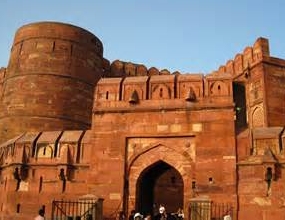
Agra Fort, is a monument, a UNESCO World Heritage site located in Agra,
Uttar Pradesh, India. It is about 2.5 km northwest of its more famous sister
monument, the Taj Mahal. The fort can be more accurately described as a
walled city. The present-day structure was built by the Mughals, though a
fort had stood there since at least the 11th century.
Agra Fort was originally a brick fort, held by the Hindu Sikarwar Rajputs.
It was mentioned for the first time in 1080 AD when a Ghaznavide force
captured it. Sikandar Lodi (1488 - 1517) was the first Sultan of Delhi who
shifted to Agra and lived in the fort. He governed the country from here and
Agra assumed the importance of the second capital.
He died in the fort at 1517 and his son, Ibrahim Lodi, held it for nine
years until he was defeated and killed at Panipat in 1526. Several palaces,
wells and a mosque were built by him in the fort during his period. After
the First Battle of Panipat in 1526, Mughals captured the fort and seized a
vast treasure, including the diamond later known as the Koh-i-Noor. The
victorious Babur stayed in the fort in the palace of Ibrahim and built a
baoli (step well) in it. The emperor Humayun was crowned here in 1530.
Humayun was defeated at Bilgram in 1540 by Sher Shah. The fort remained with
Suris till 1555, when Humanyun recaptured it. The Hindu king Hem Chandra
Vikramaditya, also called 'Hemu', defeated Humanyun's army, led by Iskandar
Khan Uzbek, and won Agra. Hemu got a huge booty from this fort and went on
to capture Delhi from the Mughals. The Mughals under Akbar defeated King
Hemu finally at the Second Battle of Panipat in 1556.
Realizing the importance of its central situation, Akbar made it his capital
and arrived in Agra in 1558. His historian, Abdul Fazal, recorded that this
was a brick fort known as 'Badalgarh' . It was in a ruined condition and
Akbar had it rebuilt with red sandstone from Barauli area in Rajasthan.
Architects laid the foundation and it was built with bricks in the inner
core with sandstone on external surfaces. Some 4,000 builders worked on it
daily for eight years, completing it in 1573.
It was only during the reign of Akbar's grandson, Shah Jahan, that the site
took on its current state. Legend has it that Shah Jahan built the beautiful
Taj Mahal for his wife, Mumtaz Mahal. Unlike his grandfather, Shah Jahan
tended to have buildings made from white marble, often inlaid with gold or
semi-precious gems. He destroyed some of the earlier buildings inside the
fort to make his own.
At the end of his life, Shah Jahan was deposed and restrained by his son,
Aurangzeb, in the fort. It is rumoured that Shah Jahan died in Muasamman
Burj, a tower with a marble balcony with a view of the Taj Mahal.
The fort was the site of a battle during the Indian rebellion of 1857, which
caused the end of the British East India Company's rule in India, and led to
a century of direct rule of India by Britain.
Layout
The 94-acre (380,000 m2) fort has a semicircular plan, its chord lies
parallel to the river and its walls are seventy feet high. Double ramparts
have massive circular bastions at intervals, with battlements, embrasures,
machicolations and string courses. Four gates were provided on its four
sides, one Khizri gate opening on to the river.
Two of the fort's gates are notable: the "Delhi Gate" and the "Lahore Gate."
The Lahore Gate is also popularly also known as the "Amar Singh Gate," for
Amar Singh Rathore.
The monumental Delhi Gate, which faces the city on the western side of the
fort, is considered the grandest of the four gates and a masterpiece of
Akbar's time. It was built circa 1568 both to enhance security and as the
king's formal gate, and includes features related to both. It is embellished
with inlay work in white marble.
A wooden drawbridge was used to cross the moat and reach the gate from the
mainland; inside, an inner gateway called Hathi Pol ("Elephant Gate") -
guarded by two life-sized stone elephants with their riders - added another
layer of security. The drawbridge, slight ascent, and 90-degree turn between
the outer and inner gates make the entrance impregnable.
During a siege, attackers would employ elephants to crush a fort's gates.
Without a level, straight run-up to gather speed, however, something
prevented by this layout, elephants are ineffective. Because the Indian
military (the Parachute Brigade in particular) is still using the northern
portion of the Agra Fort, the Delhi Gate cannot be used by the public.
Tourists enter via the Amar Singh Gate.
The site is very important in terms of architectural history. Abul Fazal
recorded that five hundred buildings in the beautiful designs of Bengal and
Gujarat were built in the fort. Some of them were demolished by Shahjahan to
make way for his white marble palaces. Most of the others were destroyed by
the British between 1803 and 1862 for raising barracks. Hardly thirty Mughal
buildings have survived on the south-eastern side, facing the river. Of
these, the Delhi Gate and Akbar Gate and one palace - "Bengali Mahal" - are
representative Akbari buildings.
Akbar Darwazza (Akbar Gate) was renamed Amar Singh Gate by the British. An
interesting mix of Hindu and Islamic architecture is found here. In fact,
some of the Islamic decorations feature haraam (sinful) images of living
creatures - dragons, elephants and birds, instead of the usual patterns and
calligraphy seen in Islamic surface decoration.
undo ...back