Fatehpur Sikri
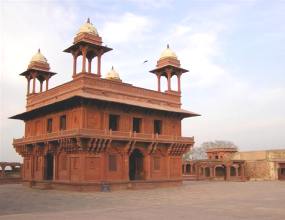
Fatehpur Sikri is a city and a municipal board in Agra district in the state
of Uttar Pradesh, India. The city was founded in 1569 by the Mughal emperor
Akbar, and served as the capital of the Mughal Empire from 1571 to 1585.
After his military victories over Chittor and Ranthambore, Akbar decided to
shift his capital from Agra to a new location 23 miles (37 km) W.S.W on the
Sikri ridge, to honor the Sufi saint Salim Chishti.
Here he commenced the construction of a planned walled city which took the
next fifteen years in planning and construction of a series of royal
palaces, harem, courts, a mosque, private quarters and other utility
buildings. He named the city, Fatehabad, with Fateh, a word of Arabic origin
in Persian, meaning "victorious."
it was later called Fatehpur Sikri. It is at Fatehpur Sikri that the legends
of Akbar and his famed courtiers, the nine jewels or Navaratnas, were born.
Fatehpur Sikri is one of the best preserved collections of Mughal
architecture in India. According to contemporary historians, Akbar took a
great interest in the building of Fatehpur Sikri and probably also dictated
its architectural style. Seeking to revive the splendours of Persian court
ceremonial made famous by his ancestor Timur, Akbar planned the complex on
Persian principles. But the influences of his adopted land came through in
the typically Indian embellishments.
The easy availability of sandstone in the neighbouring areas of Fatehpur
Sikri, also meant that all the buildings here were made of the red stone.
The imperial Palace complex consists of a number of independent pavilions
arranged in formal geometry on a piece of level ground, a pattern derived
from Arab and central Asian tent encampments. In its entirety, the monuments
at Fatehpur Sikri thus reflect the genius of Akbar in assimilating diverse
regional architectural influences within a holistic style that was uniquely
his own.
History
The Imperial complex was abandoned in 1585, shortly after its completion,
due to paucity of water and its proximity with the Rajputana areas in the
North-West, which were increasingly in turmoil. Thus the capital was shifted
to Lahore so that Akbar could have a base in the less stable part of the
empire, before moving back Agra in 1598, where he had begun his reign as he
shifted his focus to Deccan. In fact, he never returned to the city except
for a brief period in 1601.
In later Mughal history it was occupied for a short while by Mughal emperor,
Muhammad Shah (r. 1719 -1748), and his regent, Sayyid Hussain Ali Khan Barha,
one of the Syed Brothers, was murdered here in 1720. Today much of the
imperial complex which spread over nearly two mile long and one mile wide
area is largely intact and resembles a ghost town. It is still surrounded by
a five mile long wall built during its original construction, on three
sides.
However apart from the imperial buildings complex few other buildings stand
in the area, which is mostly barren, except of ruins of the bazaars of the
old city near the Naubat Khana, the 'drum-house' entrance at Agra Road. The
modern town lies at the western end of the complex, which was a municipality
from 1865 to 1904, and later made a "notified area", and in 1901 had a
population of 7,147. For a long time it was still known for its masons and
stone carvers, though in Akbar time it was known and 'fabrics of hair' and
'silk-spinning'. The village of Sikri still exists nearby.
Architecture
Fatehpur Sikri sits on rocky ridge, 3 kilometres (1.9 mi) in length and 1 km
(0.62 mi) wide, and palace city is surrounded by a 6 km (3.7 mi) wall on
three side with the fourth being a lake at the time. Its architect was Tuhir
Das and was constructed using Indian principles. The buildings of Fatehpur
Sikri show a synthesis of various regional schools of architectural
craftsmanship such as Gujarat and Bengal. This was because indigenous
craftsmen used for the construction of the buildings. Influences from Hindu
and Jain architecture are seen hand in hand with Islamic elements.
The building material used in all the buildings at Fatehpur Sikri,
palace-city complex, is the locally quarried red sandstone, known as 'Sikri
sandstone'. It is accessed through gates along the five-mile long fort wall,
namely, Delhi Gate, the Lal Gate, the Agra Gate, Birbal's Gate, Chandanpal
Gate, The Gwalior Gate, the Tehra Gate, the Chor Gate and the Ajmere Gate.
Some of the important buildings in this city, both religious and secular
are:
■ Anup Talao
■ Buland Darwaza
■ Jama Masjid
■ Tomb of Salim Chishti
■ Diwan-i-Aam
■ Diwan-i-Khas
■ Ibadat Khana
■ Hujra-i-Anup Talao
■ Mariam-uz-Zamani's Palace
■ Naubat Khana
■ Pachisi Court
■ Panch Mahal
■ Birbal's House
Access
Fatehpur Sikri is about 39 km from Agra. The nearest Airport is the Agra
Airport (also known as Kheria Airport), 40 km from Fatehpur Sikri. The
nearest railway station is the Fatehpur Sikri Railway Station, about one km.
from the city centre . It is suitably connected to Agra and neighbouring
centres by road, where regular bus services of UPSRTC ply, apart from
Tourist buses and taxies.
Sources: Wikipedia
undo ...back