Tomb of I'timād-ud-Daulah
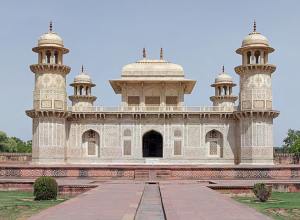
Tomb of I'timād-ud-Daulah is a Mughal mausoleum in the city of Agra in the
Indian state of Uttar Pradesh. Often described as a "jewel box", sometimes
called the "Baby Tāj", the tomb of I'timād-ud-Daulah is often regarded as a
draft of the Tāj Mahal.
Along with the main building, the structure consists of numerous
outbuildings and gardens. The tomb, built between 1622 and 1628 represents a
transition between the first phase of monumental Mughal architecture –
primarily built from red sandstone with marble decorations, as in Humayun's
Tomb in Delhi and Akbar's tomb in Sikandra – to its second phase, based on
white marble and pietra dura inlay, most elegantly realized in the Tāj Mahal.
The mausoleum was commissioned by Nūr Jahān, the wife of Jahangir, for her
father Mirzā Ghiyās Beg, originally a Persian Amir in exile. who had been
given the title of I'timād-ud-Daulah (pillar of the state). Mirzā Ghiyās Beg
was also the grandfather of Mumtāz Mahāl (originally named Arjūmand Bāno,
daughter of Asaf Khān), the wife of the emperor Shāh Jahān, responsible for
the construction of the Tāj Mahal.
Tomb
Located on the right bank of the Yamuna River, the mausoleum is set in a
large cruciform garden criss-crossed by water courses and walkways. The
mausoleum itself covers about twenty-three meters square, and is built on a
base about fifty meters square and about one meter high. On each corner are
hexagonal towers, about thirteen meters tall.
The walls are white marble from Rajasthan encrusted with semi-precious stone
decorations – cornelian, jasper, lapis lazuli, onyx, and topaz formed into
images of cypress trees and wine bottles, or more elaborate decorations like
cut fruit or vases containing bouquets. Light penetrates to the interior
through delicate jālī screens of intricately carved white marble.
Many of Nūr Jahān's relatives are interred in the mausoleum. The only
asymmetrical element of the entire complex is that the cenotaphs of her
father and mother have been set side-by-side, a formation replicated in the
Tāj Mahal.
Sources: Wikipedia
undo ...back