Akshardham
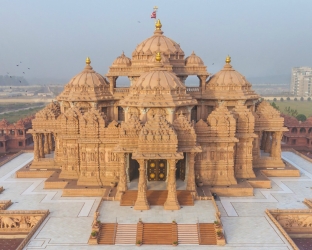
Akshardham is a Hindu temple complex in Delhi, India. Also referred to as
Delhi Akshardham or Swaminarayan Akshardham, the complex displays millennia
of traditional Hindu and Indian culture, spirituality, and architecture. The
building was inspired and developed by Pramukh Swami Maharaj, the spiritual
head of the Bochasanwasi Shri Akshar Purushottam Swaminarayan Sanstha, whose
3,000 volunteers helped 7,000 artisans construct Akshardham.
The temple, which attracts approximately 70 percent of all tourists who
visit Delhi, was officially opened on 6 November 2005. It sits near the
banks of the Yamuna adjacent to the 2010 Commonwealth Games village in
eastern New Delhi. The temple, at the center of the complex, was built
according to the Vastu Shastra and Pancharatra Shastra.
In addition to the large central temple crafted entirely of stone, the
complex features exhibitions on incidents from the life of Swaminarayan and
the history of India, an IMAX feature on the early life of Swaminarayan as
the teenage yogi, Nilkanth, a musical fountain on the message of the
Upanishads, and large landscaped gardens. The temple is named after a belief
in Swaminarayan Hinduism.
Features
Monument
The main monument, at the center of the complex, is 141-foot (43 m) high,
316-foot (96 m) wide, and 356-foot (109 m) long and is covered top to bottom
with carved details of flora, fauna, dancers, musicians, and deities.
Designed in accordance with ancient Vedic text known as the Sthapatya
Shastra, it features a blend of architectural styles from across India. It
is constructed entirely from Rajasthani pink sandstone and Italian Carrara
marble, and has no support from steel or concrete.
The monument also consists of 234 ornately carved pillars, nine domes, and
20,000 murtis and statues of Hinduism's sadhus, devotees, and acharyas. The
monument also features the Gajendra Pith at its base, a plinth paying
tribute to the elephant for its importance in Hindu culture and India's
history. It contains 148 scale sized elephants in total and weighs a total
of 3000 tons. Within the monument, under the central dome, lies a murti or
statue of Swaminarayan which is 11-foot (3.4 m) high.
The murti is surrounded by similar statues of the gurus of the sect. Each
murti is made of paanch dhaatu or five metals in accordance to Hindu
tradition. Also within the central monument lie the murtis of other Hindu
deities, including Sita Ram, Radha Krishna, Shiv Parvati, and Lakshmi
Narayan.
Exhibitions
Hall of Values
Also known as Sahajanand Pradarshan, the Hall of Values features lifelike
robotics and dioramas which display incidents from Swaminarayan's life,
portraying his message about the importance of peace, harmony, humility,
service to others and devotion to God. The Sahajanand Pradarshan is set in
18th century India and displays of 15 dioramas through robotics, fibre
optics, light and sound effects, dialogues, and music. The hall features the
world's smallest animatronic robot in the form of Ghanshyam Maharaj, the
child form of Swaminarayan.
Theatre
Named Neelkanth Kalyan Yatra, the theatre houses Delhi's first and only
large format screen, measuring 85-foot (26 m) by 65-foot (20 m). The theatre
shows a film specially commissioned for the complex, Neelkanth Yatra, to
recount a seven-year pilgrimage made by Swaminarayan made during his teenage
years throughout India. Mystic India, an international version of the film
produced by BAPS Charities, was released in 2005 at IMAX theatres and giant
screen cinemas worldwide. A 27-foot (8.2 m) tall bronze murti of Neelkanth
Varni is located outside the theatre.
Musical Fountain
Known as the Yagnapurush Kund, it is India's largest step well. It features
a very large series of steps down to a traditional yagna kund. During the
day, these steps provide rest for the visitors to the complex and at night,
a musical fountain show representing the circle of life is played to an
audience which is seated on the same steps. The fountain is named after the
founder of the Hindu organisation, Shastriji Maharaj. The fountain measures
300 feet (91 m) by 300 feet (91 m) with 2,870 steps and 108 small shrines.
In its center lies an eight-petaled lotus shaped yagna kund designed
according to the Jayaakhya Samhita of the Panchratra shastra.
Garden of India
Also known as the Bharat Upavan, this garden has lush manicured lawns,
trees, and shrubs. The garden is lined with bronze sculptures of
contributors to India's culture and history. These sculptures include
children, women, national figures, freedom fighters, and warriors of India,
including notable figures such as Mahatma Gandhi.
Additional Features
Yogi Hraday Kamal
A sunken garden, shaped like a lotus when viewed from above, features large
stones engraved with quotes from world luminaries ranging from Shakespeare
and Martin Luther King to Swami Vivekananda and Swaminarayan.
Neelkanth Abhishek
Devotees offer abhishek, a ritual of pouring water on to the murti of
Neelkanth Varni, and express their reverence and prayers for spiritual
upliftment and fulfilment of wishes.
Narayan Sarovar
The Narayan Sarovar is a lake that surrounds the main monument. The lake
contains holy waters from 151 rivers and lakes that are believed to have
been sanctified by Swaminarayan, including Mansarovar. Surrounding the
Narayan Sarovar are 108 gaumukhs, symbolising Janmangal Namavali or the 108
names for god, from which holy water issues forth.
Premvati Ahargruh
The Premati Ahargruh or the Premvati Food Court is a vegetarian restaurant
modelled on the Ajanta and Ellora caves in Maharashtra, India and an
Ayurvedic bazaar. The restaurant caters a variety of traditional dishes.
AARSH Centre
The Akshardham Centre for Applied Research in Social Harmony or the AARSH
Centre is a centre within the complex that applies research of social
harmony and related topics. Scholars and students may conduct practical
research through AARSH. Researchers have the ability to carry out their
research projects and affiliate their papers with AARSH. Studies on
education, medicare, tribal and rural welfare, ecology, and culture are
conducted within the centre.
History and Development
Planning
The building had been planned since 1968 as a vision of Yogiji Maharaj.
Yogiji Maharaj, the spiritual head of the BAPS Swaminarayan Sanstha at the
time, expressed his desire for wanting a grand temple built on the banks of
the Yamuna river to two or three devotee families of Swaminarayan that
resided in New Delhi at the time. Attempts were made to start the project,
however little progress was made. In 1971, Yogiji Maharaj died.
In 1982, Pramukh Swami Maharaj, Yogiji Maharaj's successor as the spiritual
head of BAPS, started to continue fulfilling the dream of his guru Yogiji
Maharaj and prompted devotees to look into the possibility of building the
temple in Delhi. A request for the plan was put forward to the Delhi
Development Authority (DDA), and several different places were suggested,
including Ghaziabad, Gurgaon, and Faridabad. Pramukh Swami Maharaj stood
firm in following the wishes of Yogiji Maharaj to build a temple on the
Yamuna.
In April 2000, after 18 years, the Delhi Development Authority offered 60
acres (240,000 m2) of land, and the Uttar Pradesh Government offered 30
acres (120,000 m2) for the project. Upon receiving the land, Pramukh Swami
Maharaj performed puja on the site for success in the project. Construction
on the temple began on 8 November 2000 and Akshardham was officially opened
on 6 November 2005, with the building being completed in two days short of
five years.
Development
A team of eight sadhus were assigned to oversee the Akshardham project. The
majority of the team had gained experience from work on the Akshardham in
Gandhinagar, Gujarat, Delhi Akshardham's sister complex. During development,
Pramukh Swami Maharaj was consulted in many aspects of the monument's
construction.
Around 1997 and 1998, the idea to start development on the temple, by
beginning the stone carving, had been requested. However, this idea was
denied by Pramukh Swami Maharaj who believed that the construction should
only start after the land was acquired. The initial work done on the site
was on the foundation. Due to the soft river bank, the site wasn't
considered ideal for construction. As a result, a deep foundation was
imperative. To construct a stable foundation, 15-foot (4.6 m) of rocks and
sand were entwined with wire mesh and topped by five feet of concrete. Five
million fired bricks raised the foundation another 21.5-foot (6.6 m). These
bricks were then topped by three more feet of concrete to form the main
support under the monument.
On 2 July 2001, the first sculpted stone was laid. The team of eight sadhus
consisted of scholars in the field of the Pancharatra Shastra, a Hindu
scripture on architecture and deity carving. The sadhus watched over stone
work as well as the research on carvings on Indian craftsmanship from
between eighth and twelfth century. This research was done at various sites
such as Angkor Wat, as well as Jodhpur, Jagannath Puri, Konark, and other
temples in South India.
Seven thousand carvers and three thousand volunteers were put to work for
the construction Akshardham. With over 6,000 tons of pink sandstone coming
from Rajasthan, workshop sites were set up around places within the state.
Amongst the carvers were local farmers and fifteen hundred tribal women who
had suffered from a drought and received economic gain due to this work. The
initial stone cutting was done by machine, while the detailed carvings were
done by hand. Every night, over one hundred trucks were sent to Akshardham,
where four thousand workers and volunteers operated on the construction
site.
Opening Ceremony
Akshardham was consecrated on 6 November 2005 by Pramukh Swami Maharaj and
ceremoniously dedicated to the nation by the President of India, Dr. A.P.J.
Abdul Kalam, the Prime Minister, Manmohan Singh, and the Leader of the
Opposition in the Indian Parliament, Lal Krishna Advani, with the presence
of 25,000 guests. After touring the central monument, president Kalam then
gave a speech on where Akshardham fits with society, and finished by saying:
"Pramukh Swamiji Maharaj has inspired thousands of people across the country
and abroad and brought together the best of the minds for creating a
beautiful cultural complex. It has become a place of education, experience
and enlightenment. It creatively blends the traditional stone art and
architecture, Indian culture and civilization, ancient values and wisdom and
the best of modern media and technology. Multiple layers of this complex
expresses the strength of the mind, willpower of the human being,
indomitable spirit, flowering kindness, fusion of scientific and medical
talent, myriad colors of varied cultures and ultimately the power of
knowledge. In essence, it is a dynamic complex with lively images.
... Akshardham has happened at the dawn of 21st century with the commitment
and dedication of one million volunteers. What has happened today at
Akshardham inspires me and gives me the confidence that we can do it? The
realization of developed India is certainly possible before 2020 with the
millions of ignited minds like you."
Prime Minister Singh followed by hoping that this would usher in religious
tolerance and praised the architecture of the complex. He made note of it
becoming a future landmark of India while L. K. Advani called it "the most
unique monument of the world." Pramukh Swami Maharaj ended the night's
speeches and expressed the wish that, "In this Akshardham, may one and all
find inspiration to mould their lives and may their lives become divine.
Such is my prayer to God."
Garbhagruh Renovation and Events
On 13 July 2010, a newly designed garbhagruh, or inner sanctum, was
inaugurated by Pramukh Swami Maharaj in the main monument within the
Akshardham complex. The new garbhagruh includes a decorated, canopied
sihasan, upon which the murti of Swaminarayan rests and features intricate
carvings and gold-leafed designs.
Akshardham served as a featured attraction during the 2010 Commonwealth
Games held in Delhi. Through the duration of the Games, hundreds of
athletes, teams, and enthusiasts from around the world visited the complex.
On 14 November 2010, the Swaminarayan Research Institute at Akshardham was
inaugurated through an event organised by the women's faction of the
organisation, highlighting the value of seva, or socially beneficial
volunteer efforts, in society through mandirs, churches, mosques, and other
places of worship. Anju Bhargava, the founder of the Hindu American Seva
Charities and advisor to President Barack Obama on faith-based issues,
delivered the keynote address, which emphasised the need for seva in society
and the vital role of spirituality in one's life.
Guinness World Record
On 17 December 2007, Michael Whitty, an official world record adjudicator
for Guinness World Records, travelled to Ahmedabad, India to present a new
world record to Pramukh Swami Maharaj, the spiritual leader of BAPS
Swaminarayan Sanstha, for the Akshardham complex.
The record was presented for Akshardham as the World's Largest Comprehensive
Hindu Temple.
"BAPS Swaminarayan Akshardham in New Delhi, India, is the world's largest
comprehensive Hindu temple. It measures 356 ft (109 m). long, 316 ft (96 m).
wide and 141 ft (43 m). high, covering an area of 86,342 sq ft (8,021.4 m2).
The grand, ancient-style, ornately hand-carved stone temple has been built
without structural steel within five years by 11,000 artisans and
volunteers. His Holiness Pramukh Swami Maharaj, revered spiritual leader of
BAPS, consecrated the temple on 6 November 2005. Akshardham showcases the
essence of India's ageless art, borderless culture and timeless values.
Upon presentation of the award, Michael Whitty stated, "It took us three
months of research, pouring over the extensive architectural plans of the
Akshardham and also those of other temples of comparable size, visiting and
inspecting the site, before we were convinced that Akshardham deserved the
title..."
Disputes
Three temples, the Meenakshi Amman Temple in Madurai, the Sri
Ranganathaswamy Temple in Srirangam, and the Annamalaiyar Temple in
Thiruvannamalai, all located in Tamil Nadu, India, are claimed to be larger
than Akshardham. The trustees of these temples have reportedly disputed the
Guinness World Record.
The Meenakshi temple in Madurai has the length of 850 feet (260 m) and width
of 800 feet (240 m). The entire area of this temple is 17 acres (0.069 km2),
while the Sri Ranganathaswamy temple in Srirangam covers 156 acres (0.63
km2) and the Arunachaleswarar Temple in Thiruvannamalai is 24 acres (0.097
km2). Authorities at the Meenakshi temple have argued that construction area
of the actual temple is more important than the land area.
Authorities at the Meenakshi temple have also argued that temples are places
for worship and therefore additional features and exhibitions are not
components of a temple. According to Kurien, use of modern and most
sophisticated technology is characteristic of BAPS. In Modern Transmission
of Hindu Traditions in India and Abroad, a former Leicester professor in the
Religion Department, Douglas Brear, points out BAPS' concern to transmit
comprehensive Hindu tradition in the twentieth-century. He observes that the
teachings are indeed transmitted, but the transmission mode "has to be
sensitive to the needs of the times".
Getting There
The nearest airport is Indira Gandhi International Airport (IATA: DEL, ICAO:
VIDP), situated in Palam, 15 km (9.3 mi) south-west of the New Delhi railway
station and 16 km (9.9 mi) from New Delhi city centre.
undo ...back