Chandni Chowk
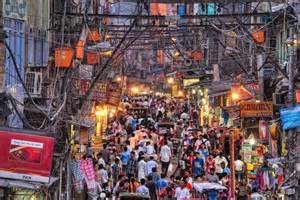
Chandni Chowk originally meaning "moonlit square" or "moonlit market", is
one of the oldest and busiest markets in Old Delhi, now in central north
Delhi, India. Built in 17th century by the Mughal emperor of India Shah
Jahan and designed by his daughter Jahan Ara, the market was once divided by
canals (now closed) to reflect moonlight, and it remains one of India's
largest wholesale markets.
History
Symbolizing the remnants of a medieval world, the Chandni Chowk today stands
at crossroads in time, looking forward to an age where modernity and
tradition promise to walk hand in hand.
The history of Chandni Chowk dates back to the foundation of the city of
Shahjahanabad when the Mughal emperor, Shah Jahan established the Red Fort
or the Laal Quila as it is also known on the banks of the River Yamuna
beside his newly founded capital city of Shahjahanabad.
Chandni Chowk or the Moonlight Square was designed and established by
Princess Jahanara, Shahjahan’s favourite daughter, in 1650 A.D. The bazaar
which was shaped as a square was given a further dash of elegance by the
presence of a pool in the center of the complex which shimmered in the
moonlight, a feature which was perhaps responsible for the nomenclature of
the marketplace. The shops of the complex were originally built in a
half-moon shape, a pattern, which, however, is lost today. The bazaar was in
the time of Shahjahan was famous for its silver merchants, which could also
have an important role to play in the nomenclature of the Chandni Chowk as
silver is referred to as Chandi in Hindi, a word which could have been
slightly deformed to form Chandni Chowk.
The Mughal imperial processions used to pass through Chandni Chowk. The
tradition was continued when Delhi Durbar was held in 1903. Delhi Town Hall
was built in 1863 by the British.
Chandni Chowk runs through the middle of the walled city, from the Lahori
Darwaza (Lahore Gate) of the Red Fort to Fatehpuri Masjid. Originally, a
canal ran through the middle of the street as a part of the water supply
scheme.
It is said that moonlight reflecting on its canal earned it its name Chandni
(Moonlit). Chandni Chowk was once the grandest of the markets in India.
Even though today Chandni Chowk appears choked with congestion, it retains
its historical character. It is a famous market known all over India. Google
India helps Delhi's iconic Chandni Chowk market go online. They approached
each of 2500 stores and even have opened common website for all the shops.
Overview
The area lies in the historically important Shahjahanabad, between the Lal
Qila (Red Fort) and Fatehpuri Masjid. On both sides of the wide Chandni
Chowk streets are historical residential areas served by narrow lanes (galis).
With the most famous mosque of Delhi, Jama Masjid, built in 1650 in the
vicinity, it is an unusual street that has several famous religious shrines,
belonging to coexisting religions, lending the street a genuine cultural
harmony.
Chandni Chowk's speciality is the variety of its markets and their
Indian-ness: from authentic Indian food, delicacies and sweets of more than
1,000 kinds, to sarees with chikan and zari work. There are many narrow
lanes with shops selling books, clothing, shoes and leather goods,
electronic and consumer goods and whatnot. The area, even more so than the
rest of the city, is very congested. This is also a good place for window
shopping. It is the location of the original Haldiram's. A particular local
delicacy are the jalebis, which are fried in pure ghee (clarified butter).
Chandni Chowk is home to several famous restaurants/confectioners (halwais).
Getting There
The nearest airport is Indira
Gandhi International Airport (IATA: DEL, ICAO: VIDP), situated in Palam,
15 km (9.3 mi) south-west of the New Delhi railway station and 16 km (9.9
mi) from New Delhi city centre.
undo ...back