Humayun's Tomb
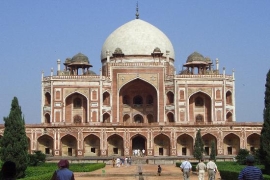
Humayun's tomb is the tomb of the Mughal Emperor Humayun. The tomb was
commissioned by Humayun's first wife Bega Begum (Haji Begum) in 1569-70, and
designed by Mirak Mirza Ghiyas, a Persian architect chosen by Bega Begum. It
was the first garden-tomb on the Indian subcontinent, and is located in
Nizamuddin East, Delhi, India, close to the Dina-panah citadel also known as
Purana Qila (Old Fort), that Humayun founded in 1533. It was also the first
structure to use red sandstone at such a scale. The tomb was declared a
UNESCO World Heritage Site in 1993, and since then has undergone extensive
restoration work, which is complete.
Besides the main tomb enclosure of Humayun, several smaller monuments dot
the pathway leading up to it, from the main entrance in the West, including
one that even pre-dates the main tomb itself, by twenty years; it is the
tomb complex of Isa Khan Niyazi, an Afghan noble in Sher Shah Suri's court
of the Suri dynasty, who fought against the Mughals, constructed in 1547 CE.
The complex encompasses the main tomb of the Emperor Humayun, which houses
the graves of Bega Begum herself, Hamida Begum, and also Dara Shikoh, great
great grandson of Humayun and son of the later Emperor Shah Jahan, as well
as numerous other subsequent Mughals, including Emperor Jahandar Shah,
Farrukhsiyar, Rafi Ul-Darjat, Rafi Ud-Daulat and Alamgir II. It represented
a leap in Mughal architecture, and together with its accomplished Charbagh
garden, typical of Persian gardens, but never seen before in India, it set a
precedent for subsequent Mughal architecture. It is seen as a clear
departure from the fairly modest mausoleum of his father, the first Mughal
Emperor, Babur, called Bagh-e Babur (Gardens of Babur) in Kabul
(Afghanistan). Though the latter was the first Emperor to start the
tradition of being buried in a paradise garden. Modelled on Gur-e Amir, the
tomb of his ancestor and Asia's conqueror Timur in Samarkand, it created a
precedent for future Mughal architecture of royal mausolea, which reached
its zenith with the Taj Mahal, at Agra.
The site was chosen on the banks of Yamuna river, due to its proximity to
Nizamuddin Dargah, the mausoleum of the celebrated Sufi saint of Delhi,
Nizamuddin Auliya, who was much revered by the rulers of Delhi, and whose
residence, Chilla Nizamuddin Auliya lies just north-east of the tomb. In
later Mughal history, the last Mughal Emperor, Bahadur Shah Zafar took
refuge here, during the Indian Rebellion of 1857, along with three princes,
and was captured by Captain Hodson before being exiled to Rangoon. At the
time of the Slave Dynasty this land was under the 'KiloKheri Fort' which was
capital of Sultan Kequbad, son of Nasiruddin (1268 - 1287).
History
After his death on 20 January 1556, Humayun's body was first buried in his
palace in Purana Quila at Delhi. Thereafter it was taken to Sirhind, in
Punjab by Khanjar Beg, because it was feared that Hindu king Hemu, who had
defeated Mughal forces in Agra and Delhi in Oct. 1556 and captured Purana
Quila, will damage the tomb. In 1558, it was seen by his son, the then
Mughal Emperor, Akbar. Akbar subsequently visited the tomb when it was about
to be completed in 1571.
The tomb of Humayun was built by the orders of Bega Begum (also known as
Haji Begum), Humayun's first wife and chief consort, and begun in 1565, nine
years after his death, and completed in 1572 AD at a cost of 1.5 million
rupees at the time. The cost for building the mausoleum was paid entirely by
Empress Bega Begum. When Humayun had died in 1556, Bega Begum was so grieved
over her husband's death that she dedicated her life thenceforth to a sole
purpose: the construction of the most magnificent mausoleum in the Empire,
at a site near the Yamuna River in Delhi for the memorial of the late
Emperor. According to Ain-i-Akbari, a 16th-century detailed document written
during the reign of Akbar, Haji Begum supervised the construction of the
tomb after returning from Mecca and undertaking the Hajj pilgrimage.
Humayun to `Abd al-Qadir Bada'uni, one of the few contemporary historians to
mention its construction, the architect of the tomb was the Persian
architect, Mirak Mirza Ghiyas (also referred to as Mirak Ghiyathuddin) who
was brought from Herat (northwest Afghanistan), and had previously designed
several buildings in Herat, Bukhara (now Uzbekistan), and others elsewhere
in India. Ghiyas, to whom the mausoleum's exquisite design is attributed was
chosen to be the architect by Empress Bega Begum. Unfortunately, before the
structure's completion, he died and so his son Sayyed Muhammad ibn Mirak
Ghiyathuddin completed his father's design in 1571.
An English merchant, William Finch, who visited the tomb in 1611, describes
the rich interior furnishing of the central chamber (in comparison to the
sparse look today). He mentioned the presence of rich carpets, and a
shamiana, a small tent above the cenotaph, which was covered with a pure
white sheet and with copies of the Quran in front along with his sword,
turban and shoes.
The fortunes of the once famous Charbagh (Four-square) gardens, which spread
over 13 hectares surrounding the monument, changed repeatedly over the years
after its construction. The capital had already shifted to Agra in 1556, and
the decline of the Mughals accelerated the decay of the monument and its
features, as the expensive upkeep of the garden proved impossible. By the
early 18th century, the once lush gardens were replaced by vegetable garden
of people who had settled within the walled area.
However, the capture of the last Mughal emperor, Bahadur Shah Zafar during
the Indian Rebellion of 1857 together with the premises, and his subsequent
sentencing to exile, along with execution of his three sons, meant that the
monument’s worst days lay ahead, as the British took over Delhi completely.
In 1860, the Mughal design of the garden was replanted to a more English
garden-style, with circular beds replacing the fours central water pools on
the axial pathways and trees profusely planted in flowerbeds. This fault was
corrected in early 20th century, when on Viceroy, Lord Curzon's orders the
original garden were restored in a major restoration project between
1903–1909, which also included lining the plaster channels with sandstone; a
1915 planting scheme, added emphasis to the central and diagonal axis by
lining it with trees, though some trees were also planted on the platform
originally reserved for tents. The 1882, the Official curator of ancient
monument in India, published his first report, which mentioned that the main
garden was let out to various cultivators, amongst them till late were the
royal descendants, who grew cabbage and tobacco in it.
During the Partition of India, in August 1947 the Purana Qila together with
Humayun's Tomb, became major refugee camps for Muslims migrating to the
newly founded Pakistan, and was later managed by the government of India.
These camps stayed open for about five years, and caused considerable damage
not only to the extensive gardens, but also to the water channels and the
principle structures. Eventually, to avoid vandalism, the cenotaphs within
the mausoleum were encased in brick. In the coming years, the Archeological
Survey of India (ASI), took on responsibility for the preservation of
heritage monuments in India, and gradually the building and its gardens were
restored. Until 1985, four unsuccessful attempts were made to reinstate the
original water features.
An important phase in the restoration of the complex, started around 1993,
when the monument was declared a World Heritage Site. This brought new
interest to its restoration, and a detailed research and excavation process
began under the aegis of the Aga Khan Trust and the ASI, culminating in
2003, when much of the complex, and gardens were finally restored, with its
historic fountains running once again after several centuries of disuse. The
restoration has been a continuous process ever since, with subsequent phases
addressing various aspects and monuments of the complex.
Architecture
Turkic and Mughal rule in the Indian subcontinent, also introduced Central
Asian and Persian styles of Islamic architecture in the region, and by the
late 12th century early monuments in this style were appearing in and around
Delhi, the capital of Delhi Sultanate. Starting with the Turkic Slave
dynasty which built the Qutb Minar (1192 AD) and its adjacent
Quwwat-ul-Islam mosque (1193 CE). North India was successive ruled foreign
dynasties in the coming centuries giving rise to the Indo-Islamic
architecture. While the prevailing style of architecture was trabeate,
employing pillars, beams and lintels, this brought in the arcuate style of
construction, with its arches and beams, which flourished under Mughal
patronage and by incorporating elements of Indian architecture, especially
Rajasthani architecture including decorative corbel brackets, balconies,
pendentive decorations and indeed kiosks or chhatris, to developed a
distinct, Mughal architecture style, which was to become a lasting legacy of
the nearly four hundred years of the Mughal rule. The combination of red
sandstone and white marble was previously seen in Delhi Sultanate period
tombs and mosques, most distinctively in the highly decorative Alai Darwaza
in the Qutub complex, Mehrauli, built in 1311 AD, under the Khilji dynasty.
The high rubble built enclosure is entered through two lofty double-storeyed
gateways on the west and south, 16 metres high with rooms on either side of
the passage and a small courtyards on the upper floors. Six-sided stars that
adorn the main gateway on the west, are also seen on the iwan of the main
tomb structure, though it has been used as ornamental cosmic symbol. The
mosque usually present alongside royal tombs, like the Taj, is conspicuously
missing from the enclosure, which has only one other structure, the tomb of
Emperor's favorite barber, now commonly known as Nai ka Gumbad
(Dome-of-barber).
The tomb built of rubble masonry and red sandstone, uses white marble as a
cladding material and also for the flooring, lattice screens (jaalis), door
frames, eaves (chhajja) and for the main dome. It stands on a vaulted
terrace eight-metre high and spread over 12,000m². It is essentially square
in design, though chamferred on the edges to appear octagonal, to prepare
ground for the design of the interior structure. The plinth made with rubble
core has fifty-six cells all around, and houses over 100 gravestones. Plus,
the entire base structure is on a raised platform, a few steps high.
Inspired by Persian architecture; the tomb reaches a height of 47 m and is
300 feet (91 m) wide, and was the first Indian building to use the Persian
double dome on a high neck drum, and measures 42.5 m, and is topped by 6 m
high brass finial ending in a crescent, common in Timurid tombs. The double
or 'double-layered' dome, has its the outer layer which supports the white
marble exterior, while the inner part gives shape to the cavernous interior
volume. As a contrast to the pure white exterior dome, rest of the building
is made up of red sandstone, with white and black marble and yellow
sandstone detailing, to relieve the monotony.
The symmetrical and simple designed on the exterior is in sharp contrast
with the complex interior floor plan, of inner chambers, which is a square 'ninefold
plan', where eight two-storyed vaulted chambers radiate from the central,
double-height domed chamber. It can be entered through an imposing entrance
iwan (high arc) on the south, which is slightly recessed, while others sides
are covered with intricate jaalis, stone lattice work. Underneath this white
dome in a domed chamber (hujra), lies the central octagonal sepulcher, the
burial chamber containing a single cenotaph, that of the second Mughal
Emperor, Humayun aligned on the north-south axis, as per Islamic tradition,
where in the head is placed to the north, while the face is turned sideways
towards Mecca.
The real burial chamber of the Emperor, however lies further away in an
underground chamber, exactly beneath the upper cenotaph, accessible through
a separate passage outside the main structure, which remains mostly closed
to visiting public. This burial technique along with pietra dura, a marble
and even stone inlay ornamentation in numerous geometrical and arabesque
patterns, seen all around the facade is an important legacy of the
Indo-Islamic architecture, and flourished in many later mausolea of the
Mughal Empire, like the Taj Mahal, where again we find twin cenotaphs and
exquisite 'pietra dura' craftsmanship.
The main chamber also carries the symbolic element, a mihrab design over the
central marble lattice or jaali, facing Mecca in the West, here instead of
the traditional Surah 24, An-Noor of Quran which is inscribed on the mihrabs,
this one is just an outline allowing light to enter directly into the
chamber, from Qibla or the direction of Mecca, thus elevating the status of
the Emperor, above his rivals and closer to divinity. This chamber with high
ceiling is then encompassed by four main octagonal chambers on two floors,
set at the diagonals with arched lobbies leading to them also connecting
them, plus there are four auxiliary chambers in between suggesting that the
tomb was built as a dynastic mausoleum.
Collectively the concept of eight side chambers not only offers passage for
circumambulation of the main cenotaph, a practice common in Sufism and also
visible in many Mughal imperial mausoleums, it also the reflect the concept
of Paradise in Islamic cosmology. Each of the main chambers has in turn
eight more, smaller chambers radiating from them, and thus the symmetrical
ground plan reveals itself to contain 124 vaulted chambers in all. Many
smaller chambers too, contain cenotaphs of other members of the Mughal royal
family and nobility, all within main walls of the tomb. Prominent among them
cenotaphs of Hamida Begum herself, alongside Dara Shikoh. In all there are
over 100 graves within the entire complex, including many on the first level
terrace, earning it the name "Dormitory of the Mughals", since the graves
are not inscribed their identification remains uncertain.
The building was first to use its unique combination of red sandstone and
white marble, and includes several elements of Indian architectural, like
the small canopies, or chhatris surrounding the central dome, popular in
Rajasthani architecture and which were originally covered with blue tiles.
Char Bagh Garden
While the main tomb took over eight years to build, it was also placed in
centre of a 30-acre (120,000 m2) Char Bagh Garden (Four Gardens), a
Persian-style garden with quadrilateral layout and was the first of its kind
in the South Asia region in such a scale. The highly geometrical and
enclosed Paradise garden is divided into four squares by paved walkways (khiyabans)
and two bisecting central water channels, reflecting the four rivers that
flow in jannat, the Islamic concept of paradise. Each of the four square is
further divided into smaller squares with pathways, creating into 36 squares
in all, a design typical of later Mughal gardens. The central water channels
appear to be disappearing beneath the tomb structure and reappearing on the
other side in a straight line, suggesting the Quranic verse, which talks of
rivers flowing beneath the 'Garden of Paradise'.
The entire tomb and the garden is enclosed within high rubble walls on three
sides, the fourth side was meant to be the river Yamuna, which has since
shifted course away from the structure. The central walkways, terminate at
two gates: a main one in the southern wall, and a smaller one in the western
wall. It has two double-storey entrances, the West gate which used now,
while the South gate, which was used during Mughal era, now remains closed.
Aligned at the centre on the eastern wall lies a baradari, literally a
pavilion with twelve doors, which is a building or room with twelve doors
designed to allow the free draught of air through it, finally on the
northern wall lies a hammam, a bath chamber.
Barber's Tomb
Towards the south-east corner, within the 'char bagh' garden, lies a tomb
known as Nai-ka-Gumbad, or Barber's Tomb, belonging to royal barber, it is
datable to 1590-91 CE, through an inscription found inside. Its proximity to
the main tomb and the fact that it is the only other structure within the
main tomb complex suggests its importance, however there are no inscriptions
suggesting as to who is interred therein, the name Barbers tomb is the local
name of the structure, hence still in use.
The tomb stands on a raised platform, reached by seven steps from the south,
it has a square plan and consists of a single compartment covered with a
double-dome. Inside lie two graves each inscribed with verses from the Quran.
Also, one of the graves is inscribed with the figure 999 which may stand for
the Hijra year 1590-91. However in an 1820 watercolour now at British
Library, the Persian caption beneath the structure reads, Maqbarah-i-Kokah
i.e. "Tomb of Kokah", and Kokah or Koka in Persian stand for foster-brother
(milk brother), though the identity of the person remains unknown, and it
might be (incorrectly) referring to another nearby monument in the Chausath
Khamba complex, the tomb Ataga Khan, the foster brother of Humayun, which
lies in Nizamuddin West area and not to the east of the Humayun's tomb.
Other monuments
Tomb and mosque of Isa Khan: Several monuments dot the pathway leading up to
the tomb enclosure from the main entrance in the West. Prominent among them
is one that pre-dates the main tomb itself, by twenty years. Constructed in
1547 CE, it is the tomb complex of Isa Khan Niyazi, an Afghan noble in Sher
Shah Suri's court of the Suri dynasty, who fought against the Mughals. The
octagonal tomb is positioned within an octagonal garden, which was built
during his own lifetime and the reign of Islam Shah Suri, son of Sher Shah.
It later served as a burial place for the entire family of Isa Khan. On the
western side of the tomb lies a three-bay wide mosque, in red sandstone. The
octagonal tomb bears a striking resemblance to other tombs of the Sur
dynasty monuments in the Lodhi Gardens, in Delhi and demonstrates a marked
progression in the development of the exquisite architectural style of the
main tomb. Some of the architectural details present here were seen later in
the main Humayun's tomb, though on a much grander scale, such as the tomb
being placed in a walled garden enclosure.
Afsarwala tomb (Officer's tomb), adjoining the Afsarwala mosque, built in
1566 AD, within the Arab Sarai complex.
Bu Halima's Tomb and Garden: When entering the complex from the West,
visitor's first enter a garden complex, known as Bu Halima's Garden, though
little is known about her, and since the tomb or the raised platform where
it once stood is not at the centre, it appears to be a later addition.
Afsarwala Tomb and mosque: Standing southwest end of the complex, lies the
Afsarwala tomb (Officer's Tomb) belonging to a nobleman (Afsar Indianized
word for Officer) in Akbar's court. One of the marble graves inside the tomb
is dated 1566-67 CE. The mosque itself can be dated to the same period
judging from its siting, standing as it does adjacent to the tomb, rather
than away from it.
Arab Sarai: Literally meaning the sarai (resthouse) for the Arabs, the
structure stands adjacent to the Afsarwala mosque and was built by Bega
Begum around 1560-1561 CE, ostensibly built for the craftsmen who came for
the construction work. It could accommodate 300 Arabs.
Nila Gumbad: Standing outside the boundary of the complex is the tomb known
as Nila Burj (now known as Nila Gumbad) or 'Blue Dome', so called because it
carries striking blue glazed tiles. It was built by Abdul Rahim Khan-I-Khana,
son of Bairam Khan also a courtier in Mughal Emperor, Akbar's court, for his
servant Miyan Fahim. Fahim, who not only grew up with his son, but later
also died alongside one of Rahim's own sons, Feroze khan, while fighting
against the rebellion of Mughal general Mahabat Khan in 1625/26, during the
reign of Jahangir. This structure is known for its unique architecture, as
it is octagonal on the outside while square within; its ceiling is decorated
with painted and incised plaster, it has a high neck dome and shows a
conspicuous absence of a double dome feature, common to tombs of the period.
Chillah Nizamuddin Aulia: Believed to be the residence of patron saint of
Delhi, Nizamuddin Auliya (d. 1325 A.D), is located just outside the main
complex, near the northeastern corner of the principle mausoleum and is an
example of Tughlaq period architecture.
Yet further away from the tomb complex, lie Mughal-period monuments, Bada
Bateshewala Mahal, the tomb of Muzaffar Husain Mirza, the grand nephew of
Humayun, built 1603-4 on platform with five arches on each side, has its
interior walls decorated with incised and painted plaster; the Chote
Bateshewala Mahal once an arcaded octagonal building with a domed ceiling
and stone jaalis. Both these monument now lie inside a commercial area
facing the complex's parking lot. Another period structure is Barapula, a
bridge with 12 piers and 11 arched openings, built in 1621 by Mihr Banu Agha,
the chief eunuch of Jahangir’s court.
Restoration
Before the restoration work was undertaken, vandalism and illegal
encroachments were rampant at the site of the tomb, presenting a serious
danger to the preservation of this invaluable treasure. At the main entrance
of Humayun’s Tomb, dingy stalls had been put up under a very corrupt system
of municipal patronage known as tehbazari, and all sorts of heavy vehicles
were allowed to be parked illegally in these open spaces. On the Nila Gumbad
side was a huge citadel of India’s vote bank politics - thousands of ‘slum
dwellers’ were kept by an influential section of the political leadership to
serve as ‘bonded voters’ during elections. The environment of the dargah of
Hazrat Nizamuddin Auliya had also been ruthlessly degraded and the holy tank
had become a messy cesspool.
Restoration work by the Aga Khan Trust for Culture (AKTC), in collaboration
with Archaeological Survey of India (ASI), began around 1999 after research
work, which started in 1997, and was completed in March 2003. Around 12
hectares of lawns were replanted, and over 2500 trees and plants, including
mango, lemon, neem, hibiscus and jasmine cuttings, were planted in the
gardens. Installation of a new water circulation system for the walkway
channels was also undertaken. To ensure that water flowed naturally through
the channels and pools on the 12-hectare (30 acre) site without the aid of
hydraulic systems, the water channels were re-laid to an exacting grade of
one centimetre every 40 metres (1:4000 scale).
This eventually enabled water to flow through the watercourses in the
gardens, and dormant fountains to start functioning once again. Other tasks
in this mammoth restoration project included setting up a rainwater
harvesting system using 128 ground water recharge pits, and desilting and
revitalizing old wells that were discovered during the restoration work.
This was first a privately funded collaborative effort under the aegis of
the National Cultural Fund (NCF) by the ASI. Funding included a sum of
$650,000 from the Aga Khan Trust for Culture of His Highness the Aga Khan,
with help from the Oberoi Hotels Group. In addition, AKTC is conducting a
more significant restoration at Babur's tomb, the resting place of Humayun's
father in Kabul.
After the restoration work, the conditions in and around this complex
underwent a sea-change. All the stalls and other intrusions were removed and
the monuments and green spaces restored. Elegant gardens now surround the
monuments, adding to their dignity and grace. When illuminated at night, the
monument looks truly magnificent.
In 2009, as a part of the on-going restoration work, the ASI and AKTC, after
months of manual work using hand-tools, removed from the roof a thick layer
of cement concrete that had been exerting pressure of about 1,102 tons on
the structure. The cement concrete was originally laid in the 1920s to
prevent water seepage, and led to a blockage in water passages.
Subsequently, each time there was leakage, a fresh layer of cement was
added, leading to an accumulated thickness of about 40 cm; this has now been
replaced with a traditional lime-based roof layer. In the next phase,
similar treatment was given to the tomb's first chabutra (plinth), which was
originally paved with large blocks of quartzite stone, some weighing over a
1,000 kg. In the 1940s, an uneven settlement in the lower plinth had been
corrected by covering it with a layer of concrete, adding to the
disfigurement of the original Mughal flooring, which matched with that at
the West Gate.
The Mausoleum Today
At present, threats to this monument arise from a potential terrorist attack
or from vandalism as well as the regular mushrooming of illegal
constructions and plastic waste thrown within the prohibited area around
Humayun's Tomb. Threats of terrorist attack also lead to a sharp decline in
tourist revenue which directly affects the upkeep of the monuments.
The Mumbai terrorist attacks of late 2008 saw a fall in tourist traffic to
Humayun's tomb by more than 6000 in two months. Ill thought out construction
plans like The Delhi Government's plans in 2006/2007 to build a new tunnel
to connect East Delhi to Jawaharlal Nehru Stadium, Delhi in South Delhi, and
to widen the roads near the tomb for the 2010 Commonwealth Games to connect
National Highway 24 with Lodhi Road, also posed a serious threat to the
monument. Urban planners feared that the historic monument would not have
been able to withstand the vibrations ensuing from the construction work in
such close proximity. Finally, the Archaeological Survey of India was able
to halt the plans.
During his visit to India in November 2010, US President Barack Obama
visited this site.
Getting There
The nearest airport is Indira
Gandhi International Airport (IATA: DEL, ICAO: VIDP), situated in Palam,
15 km (9.3 mi) south-west of the New Delhi railway station and 16 km (9.9
mi) from New Delhi city centre.
undo ...back