India Gate
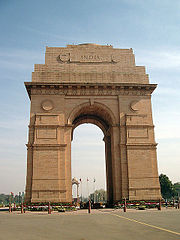
The India Gate is the national monument of India. Situated in the heart of
New Delhi, it was designed by Sir Edwin Lutyens. It commemorates the 70,000
Indian soldiers who lost their lives fighting for the British Army during
the World War I. The memorial bears the names of more than 13,516 British
and Indian soldiers killed in the Northwestern Frontier in the Afghan war of
1919.
The foundation stone of India Gate was laid by His Royal Highness, the Duke
of Connaught in 1921. The monument was dedicated to the nation 10 years
later by the then Viceroy, Lord Irwin. Originally, a statue of George V,
Emperor of India stood under the now vacant canopy in front of the India
Gate, but it was removed to Coronation Park together with a number of other
British Raj-era statues. Following India's independence, the India Gate
became the site of the Indian Armed Forces's Tomb of the Unknown Soldier,
known as Amar Jawan Jyoti ("the flame of the immortal soldier").
Site
Until the 1920s, the Old Delhi Railway Station served the entire city, and
the Agra–Delhi railway line cut through what is today known as Lutyens'
Delhi and the site of the India Gate on Kingsway (now Rajpath). Eventually
the line was shifted to run along the Yamuna river, and when that route
opened in 1924, the construction of the memorial site could begin. The New
Delhi Railway Station was opened in 1926, ahead of the inauguration of the
city of the same name in 1931.
The 42-metre tall India Gate is situated in such a way that many important
roads spread out from it. Traffic passing around India Gate used to be
continuous until the roads were closed to the public. The lawns around
Rajpath throng with people during the evening, when the monument is lit up.
The entire arch stands on a low base of red Bharatpur stone and rises in
stages to a huge moulding. The cornice is inscribed with the Imperial suns
while both sides of the arch have INDIA, flanked by the dates MCMXIV (1914
left) and MCMXIX (1919 right). The shallow domed bowl at the top was
intended to be filled with burning oil on anniversaries but this is rarely
done.
Burning as a shrine under the arch of India Gate since January 26, 1971 is
the "Amar Jawan Jyoti" (the flame of the immortal warrior), which marks the
Tomb of the Unknown Soldier, an Indian soldier killed during the First World
War. It was unveiled by Indira Gandhi, in the wake of the 1971
Indo-Pakistani War.
It has become both a source of pride for Indians as well as a major tourist
site. The India Gate hexagon complex, with a diameter of about 625 metres,
covers approximately 306,000m² in area. The Republic Day Parade starts from
Rashtrapati Bhavan and passes through India Gate.
Canopy
Standing behind the gate is an empty canopy made out of sandstone, also
designed by Lutyens, and inspired by a sixth-century pavilion from
Mahabalipuram. In recent years rumours of placing a statue of Mohandas
Gandhi or another national hero have circulated, but as of September 2013 no
plans have been made to do such a thing.
Lutyens used four Delhi Order columns to support the domed canopy and its
chhajja. The Delhi Order, which he had devised while designing Rashtrapati
Bhavan, was his own new order of classical architecture, with small bells
hanging from the capitals of the columns.
From its opening to the 1960s, the canopy opposite India Gate housed a
fifty-foot tall statue of King George V. It is made of marble and is also
designed by Sir Edwin Lutyens. It features King George standing on top of a
very tall pedestal wearing his Coronation Robes and the Imperial State
Crown. On the pedestal is the Royal Coat of Arms and the words GEORGE V R I
(R I Stand for Rex Imperator, Latin for King Emperor). Near the top is the
emblem of British India, the Order of the Star of India. Originally King
George held the British orb and sceptre, but some time after or during the
statue's removal they were broken off.
Getting There
The nearest airport is Indira
Gandhi International Airport (IATA: DEL, ICAO: VIDP), situated in Palam,
15 km (9.3 mi) south-west of the New Delhi railway station and 16 km (9.9
mi) from New Delhi city centre.
undo ...back