Qutub Minar
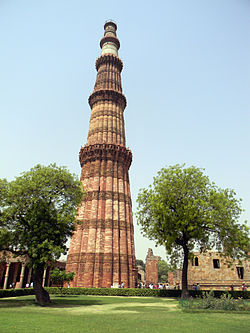
Qutb Minar, also spelled Qutub or Qutab, is the tallest minar (73 metres) in
India originally an ancient Islamic Monument, inscribed with Arabic
inscriptions, and is a UNESCO World Heritage Site. Located in Delhi, the
Qutb Minar is made of red sandstone and marble. The stairs of the tower has
379 steps, is 72.5 metres (237.8 ft) high, and has a base diameter of 14.3
metres, which narrows to 2.7 metres at the top. Construction was started in
1192 by Qutb-ud-din Aibak and was carried on by his successor, Iltutmish. In
1368, Firoz Shah Tughlak constructed the fifth and the last storey. It is
surrounded by several other ancient and medieval structures and ruins,
collectively known as the Qutb complex.
History
The minar is itself built on the ruins of the Lal Kot, the Red Citadel in
the city of Dhillika, the capital of the Tomars and the Chauhans, the last
Hindu rulers of Delhi. One engraving on the minar reads, "Shri Vishwakarma
prasade rachita" (Conceived with the grace of Vishwakarma). It was built by
Qutb-ud-din Aibak.
Numerous inscriptions in Parso-Arabic and Nagari characters in different
sections of the Qutb Minar reveal the history of its construction. According
to the inscriptions on its surface it was repaired by Firoz Shah Tughlaq (AD
1351 - 88) and Sikandar Lodi (AD 1489 - 1517). The Qubbat-ul-Islam Mosque,
located at the northeast of Minar, was built by Qutb deen Aibak in AD 1198.
It is the earliest mosque built by the Delhi Sultans. Later, a coffee arched
screen was erected and the mosque was enlarged by Iltutmish (AD 1210–35) and
Alauddin Khilji.
The minar was used as a watch tower. The earliest extant mosque was built by
the Delhi Sultans. Some historians believe that the minar was named after
the Turkish sultan (whose descendant- Wajid Ali Shah-repaired it),
Qutb-ud-din Aibak, but others contend that it was named in honour of
Qutbuddin Bakhtiar Kaki, a saint from Transoxiana who came to live in India
and was venerated by Iltutmish.
The minar has been damaged by earthquakes and lightning strikes on several
occasions but has been repaired and renovated by various rulers. During the
rule of Firoz Shah, the minar's two top floors were damaged due to lightning
but were repaired by Firoz Shah. In 1505, an earthquake struck and it was
repaired by Sikandar Lodi. Later in 1794, the minar suffered another
earthquake and it was Major Smith, an engineer, who repaired the affected
parts of the minar. He replaced Firoz Shah's pavilion at the top of the
tower with his own pavilion. This pavilion was removed in 1848 by Lord
Hardinge and now stands between the Dak Bungalow and the Minar in the
garden. The floors built by Firoz Shah can be distinguished easily as the
pavilion was built of white marble and quite smooth compared to the others.
Before 1981, the general public could climb to the top up the seven-storey,
narrow staircase. However, on 4 December 1981 an accident occurred when an
electricity cut plunged the tower's staircase into darkness. Around 45
people were killed in the stampede that followed the electricity failure.
Most of the victims were children because, before 1981, school children were
allowed free access to historical monuments on Fridays, and many school
groups were taking advantage of this. Subsequently, public access has been
forbidden.
Architecture
The minar is made of red sandstone covered with intricate carvings and
verses from the Qur'an. The minar comprises several superposed flanged and
cylindrical shafts, separated by balconies carried on Muqarnas corbels.
The first three storeys are made of red sandstone; the fourth and fifth
storeys are of marble and sandstone. At the foot of the tower is the
Quwwat-ul-Islam Mosque, the first mosque to be built in India. The nearby 7
metres high Iron Pillar is a metallurgical curiosity, standing in the Qutb
complex. The pillar has Brahmic inscriptions on it that predate the Islamic
minar.
The minar tilts just over 60 cm from the vertical, which is considered to be
within safe limits, although experts have stated that monitoring is needed
in case rainwater seepage further weakens the foundation.
Getting There
The nearest airport is Indira
Gandhi International Airport (IATA: DEL, ICAO: VIDP), situated in Palam,
15 km (9.3 mi) south-west of the New Delhi railway station and 16 km (9.9
mi) from New Delhi city centre.
undo ...back