Rashtrapati Bhavan
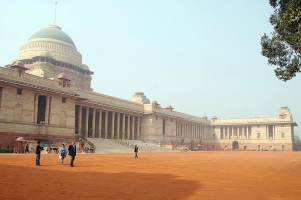
Rashtrapati Bhavan (Hindi for Presidential Residence) is the official home
of the President of India. It may refer to only the mansion (the 340-room
main building) that has the President's official residence, halls, guest
rooms and offices; it may also refer to the entire 130 hectare (320 acre)
President Estate that additionally includes huge presidential gardens (Mughal
Gardens), large open spaces, residences of bodyguards and staff, stables,
other offices and utilities within its perimeter walls. The main palace
building was formerly known as Viceroy's House.
History
The decision to build a residence in New Delhi for the British Viceroy was
taken after it was decided in the Delhi Durbar of 1911 that the capital of
India would be shifted from Calcutta (Kolkata) to Delhi in the same year.
When the plan for a new city, New Delhi, adjacent to and south of Old Delhi,
was developed in the beginning of the 20th century, the new palace for the
Viceroy of India was given an enormous size and prominent position. About
4,000 acres of land was acquired to begin the construction of Viceroy's
House.
It was officially called, and adjacent Central Secretariat between 1911 and
1916 by relocating Raisina and Malcha villages that existed there and their
300 families under the 1894 Land Acquisition Act. The British architect
Edwin Landseer Lutyens, a major member of the city-planning process, was
given the primary architectural responsibility. The completed
Governor-General's palace turned out very similar to the original sketches
which Lutyens sent Herbert Baker, from Simla, on 14 June 1912.
Lutyens' design is grandly classical overall, with colours and details
inspired by Indian architecture. Lutyens and Baker who had been assigned to
work on Viceroy's House and the Secretariats, began on friendly terms. Baker
had been assigned to work on the two secretariat buildings which were in
front of Viceroy's House. The original plan was to have Viceroy's House on
the top of Raisina Hill, with the secretariats lower down. It was later
decided to build it 400 yards back, and put both buildings on top of the
plateau. While Lutyens wanted Viceroy's House to be higher, he was forced to
move it back from the intended position, which resulted in a dispute with
Baker. After completion, Lutyens argued with Baker, because the view of the
front of the building was obscured by the high angle of the road.
Lutyens campaigned for its fixing, but was not able to get it to be changed.
Lutyens wanted to make a long inclined grade all the way to Viceroy's House
with retaining walls on either side. While this would give a view of the
house from further back, it would also cut through the square between the
secretariat buildings.
The committee with Lutyens and Baker established in January 1914 said the
grade was to be no steeper than 1 in 25, though it eventually was changed to
1 in 22, a steeper gradient which made it more difficult to see the
Viceroy's palace. While Lutyens knew about the gradient, and the possibility
that the Viceroy's palace would be obscured by the road, it is thought that
Lutyens did not fully realise how little the front of the house would be
visible.
In 1916 the Imperial Delhi committee dismissed Lutyens's proposal to alter
the gradient. Lutyens thought Baker was more concerned with making money and
pleasing the government, rather than making a good architectural design.
Lutyens travelled between India and England almost every year for twenty
years, to work on the building of Viceroy's House in both countries. Lutyens
had to reduce the building size from 13,000,000 cubic feet (370,000 m3) to
8,500,000 cubic feet (240,000 m3) because of the budget restrictions of Lord
Hardinge. While he had demanded that costs be reduced, he nevertheless
wanted the house to retain a certain amount of ceremonial grandeur.
When Chakravarti Rajagopalachari assumed the office as the first Governor
General of India and became the occupant of this building he preferred to
stay in a few rooms which is now the family wing of the President and
converted the then Viceroy's apartments to be the Guest Wing where the Heads
of State of other countries stay during their visit to India. On 26 January
1950, when Rajendra Prasad became the first President of India and occupied
this building, it was renamed as Rashtrapati Bhavan - the President's House.
Architecture Designs
This vast mansion has got four floors and 340 rooms. With a floor area of
200, 000 square feet it is built by using 700 million bricks and three
million cubic feet of stone. Hardly any steel has gone into the construction
of the building.
Various Indian designs were added to the building. These included several
circular stone basins on top of the building, as water features are an
important part of Indian architecture. There was also a traditional Indian
chujja or chhajja, which occupied the place of a frieze in classical
architecture; it was a sharp, thin, protruding element which extended 8 feet
(2.4 m) from the building, and created deep shadows. It blocks harsh
sunlight from the windows and also shields the windows from heavy rain
during the monsoon season.
On the roofline were several chuttris, which helped to break up the flatness
of the roofline not covered by the dome. Lutyens appropriated some Indian
designs, but used them sparingly and effectively throughout the building.
There were also statues of elephants and fountain sculptures of cobras in
the gar of the retaining walls, as well as the bas-reliefs around the base
of the Jaipur Column, made by British sculptor, Charles Sargeant Jagger. The
column has a "distinctly peculiar crown on top, a glass star springing out
of bronze lotus blossom". There were grilles made from red sandstone, called
jalis or jaalis. These jalis were inspired by Rajasthani design. The front
of the palace, on the east side, has twelve unevenly spaced massive columns
with the Delhi Order capitals.
These capitals have a fusion of acanthus leaves with the four pendant Indian
bells. The bells are similar in style to Indian Hindu and Buddhist temples,
the idea being inspired from a Jain temple at Moodabidri in Karnataka. One
bell is on each corner at the top of the column. It was said that as the
bells were silent British rule in India would not end. The front of the
building does not have windows, except in the wings at the sides. Lutyens
established ateliers in Delhi and Lahore to employ local craftsmen. The
chief engineer of the project was Sir Teja Singh Malik, and four main
contractors included Sir Sobha Singh.
Lutyens added several small personal elements to the house, such as an area
in the garden walls and two ventilator windows on the stateroom to look like
the glasses which he wore. The Viceregal Lodge was completed largely by
1929, and (along with the rest of New Delhi) inaugurated officially in 1931.
Interestingly, the building took seventeen years to complete and eighteen
years later India became independent. After Indian independence in 1947, the
now ceremonial Governor-General continued to live there, being succeeded by
the President in 1950 when India became a republic and the house was renamed
"Rashtrapati Bhavan". Lutyens stated that the dome is inspired by the
Pantheon of Rome.
There is also the presence of Mughal and European colonial architectural
elements. Overall the structure is distinctly different from other
contemporary British Colonial symbols. It has 355 decorated rooms and a
floor area of 200,000 square feet (19,000 m²). The structure includes 700
million bricks and 3.5 million cubic feet (85,000 m³) of stone, with only
minimal usage of steel.
Plan
The plan of the building is designed around a massive square with multiple
courtyards and open inner areas within. The plan called for two wings; one
for the Viceroy and residents and another for guests. The residence wing is
a separate four-storey house in itself, with its own court areas within.
This wing was so large that the last Indian governor-general, Chakravarti
Rajagopalachari, opted to live the smaller guest wing, a tradition that has
since been followed by subsequent presidents. The original residence wing is
now used primarily for state receptions and as a guest wing for visiting
heads of state.
The centre of the main wing of the building, underneath the main dome, is
the Durbar Hall, which was known as the Throne Room during British rule when
it had thrones for the Viceroy and Vicereine (his wife). The interior of
this room and almost all the rooms of the palace are bare, relying on
stonework and shapes to show austerity rather than intricate decoration. In
the hall, the columns are made in Delhi Order which combines vertical lines
with the motif of a bell. The vertical lines from the column were also used
in the frieze around the room, which could not have been done with one of
the traditional Greek orders of columns.
The hall has a 2-ton chandelier which hangs from a 33-metre height. The two
state drawing rooms, the state supper room and the state library are each on
the four corners of the hall. There are also other rooms such as many
loggias (galleries with open air on one side) which face out into the
courtyards, a large dining hall with an extremely long table, sitting rooms,
billiards rooms, and a large ball room, and staircases. Water features are
also through the palace, such as near the Viceroy's stairs, which has eight
marble lion statues spilling water into six basins. These lions were
symbolic of the heraldry of Great Britain. There is also an open area in one
room to the sky, which lets in much of the natural light.
Dome
The dome in the middle involved a mixture of Indian and British styles. In
the centre was a tall copper dome surmounted on top of a drum, which stands
out from the rest of the building, due to its height. The dome is exactly in
the middle of the diagonals between the four corners of the building.
The dome is more than twice the height of the rest of the building. The
height of the dome was increased by Lord Hardinge in the plan of the
building in 1913. The dome combines classical and Indian styles. Lutyens
said the design evolved from that of the Pantheon in Rome, while it is also
possible that it was modelled partly after the great Stupa at Sanchi.
The dome is supported by evenly spaced columns which form a porch with open
area between the columns. In the New Delhi summer heat haze this gives an
impression of the dome being afloat. The reinforced concrete shell of the
outer dome began to be formed at the beginning of 1929. The last stone of
the dome was laid on 6 April 1929.
Mughal Gardens
The Mughal Gardens situated at the back of the Rashtrapati Bhavan,
incorporates both Mughal and English landscaping styles and feature a vast
variety of flowers. The Rashtrapati Bhavan gardens are open to public in
February every year.
Main garden: Two channels running North to South and two running East to
West divide this garden into a grid of squares. There are six lotus shaped
fountains at the crossings of these channels. Wheresas the energetic
fountains rising up to a height of 12 feet create soothing murmur that
enthralls the visitor, the channels are so tranquil in their movement that
they seem frozen. In the channels at appropriate times of day can be seen
reflections of the imposing building and the proud flowers. There are wooden
trays placed on stands in the centre of the channels where grain is put for
the birds to feed upon.
Terrace garden: There are two longitudinal strips of garden at a higher
level on either side of the Main Garden forming the Northern and Southern
boundary. The plants grown are the same as in the Main Garden. At the centre
of both the strips is a fountain which falls inwards forming a well. On the
Western tips are located two gazebos and on the Eastern tips two ornately
designed sentry posts.
Long Garden or the 'Purdha Garden': This is located to the West of the Main
Garden, and runs along on either side of the central pavement which goes to
the circular garden. Enclosed in walls about 12 feet high this is
predominantly a rose garden. It has 16 square rose beds encased in low
hedges. There is a red sandstone pergola in the centre over the central
pavement which is covered with Rose creepers, Petrea, Bougainvillea and
Grape Vines. The walls are covered with creepers like Jasmine, Rhyncospermum,
Tecoma Grandiflora, Bignonia Vanista, Adenoclyma, Echitice, Parana
Paniculata. Along the walls are planted the China Orange trees.
Around the circular garden there are rooms for Office of the horticulturist,
a green house, stores, nursery etc. Here is housed the collection of
Bonsais, one of the best in the country. All the presidents who have stayed
at the Rashtrapati Bhavan have taken keen interest in the maintenance and
upkeep of the Mughal Gardens. All have contributed in their own way. The
underlying themes however have remained unaltered.
Restoration
First restoration project at the Rashtrapati Bhavan was started in 1985 and
ended in 1989, during which the Ashoka Hall was stripped of its later
additions and restored to its original state by the work done by
architectural restorer, Sunita Kohli. The second restoration project, begun
in 2010, involved Charles Correa and Sunita Kohli.
Getting There
The nearest airport is Indira
Gandhi International Airport (IATA: DEL, ICAO: VIDP), situated in Palam,
15 km (9.3 mi) south-west of the New Delhi railway station and 16 km (9.9
mi) from New Delhi city centre.
undo ...back