The Red Fort
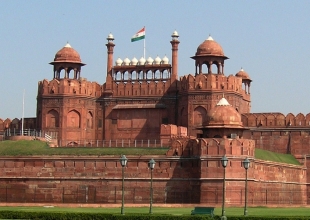
The Red Fort was the residence of the Mughal emperors of India for nearly
200 years, until 1857. Open to the public, it is located in the centre of
Delhi and houses a number of museums. In addition to accommodating the
emperors and their households, it was the ceremonial and political centre of
Mughal government and the setting for events critically impacting the
region.
The Red Fort was built as the fortified palace of Shahjahanabad, capital of
the fifth Mughal Emperor Shah Jahan, in 1648. Named for its massive
enclosing walls of red sandstone, it is adjacent to the older Salimgarh
Fort, built by Islam Shah Suri in 1546.
The imperial apartments consist of a row of pavilions, connected by a water
channel known as the Stream of Paradise (Nahr-i-Behisht). The Red Fort is
considered to represent the zenith of Mughal creativity under Shah Jahan.
Although the palace was planned according to Islamic prototypes, each
pavilion contains architectural elements typical of Mughal building,
reflecting a fusion of Timurid, Persian and Hindu traditions. The Red Fort’s
innovative architectural style (including its garden design) influenced
later buildings and gardens in Delhi, Rajasthan, Punjab, Kashmir, Braj,
Rohilkhand and elsewhere. With the Salimgarh Fort, it was designated a
UNESCO World Heritage Site in 2007 as part of the Red Fort Complex.
Name
Its English name, "Red Fort", is a translation of the Hindustani Lal Quila
deriving from its red-sandstone walls. As the residence of the imperial
family, the fort was originally known as the "Blessed Fort" (Quila-i-Mubarak).
Agra Fort is also called Lal Quila.
History
Shah Jahan commissioned the construction of the Red Fort in 1638, when he
decided to shift his capital from Agra to Delhi. Its design is credited to
architect Ustad Ahmad Lahauri. The fort lies along the Yamuna River, which
fed the moats surrounding most of the walls. Construction began in the
sacred month of Muharram, on 13 May 1638. Supervised by Shah Jahan, it was
completed in 1648. Unlike other Mughal forts, the Red Fort's boundary walls
are assymmetrical to contain the older Salimgarh Fort. The fortress-palace
was a focal point of the medieval city of Shahjahanabad (present-day Old
Delhi). Its planning and aesthetics represent the zenith of Mughal
creativity prevailing during Shah Jahan's reign. His successor Aurangzeb
added the Pearl Mosque to the emperor's private quarters, constructing
barbicans in front of the two main gates to make the entrance to the palace
more circuitous.
The administrative and fiscal structure of the Mughals declined after
Aurangzeb, and the 18th century saw a degeneration of the palace. When
Jahandar Shah took over the Red Fort in 1712, it had been without an emperor
for 30 years. Within a year of beginning his rule, Shah was murdered and
replaced by Farukhsiyar. To raise money, the silver ceiling of the Rang
Mahal was replaced by copper during this period. Muhammad Shah, known as
Rangila (the Colourful) for his interest in art, took over the Red Fort in
1719. In 1739, Persian emperor Nadir Shah easily defeated the Mughal army,
plundering the Red Fort (including the Peacock Throne). Nadir Shah returned
to Persia after three months, leaving a destroyed city and a weakened Mughal
empire to Muhammad Shah. The internal weakness of the Mughal empire made the
Mughals titular heads of Delhi, and a 1752 treaty made the Marathas
protectors of the throne at Delhi.
The 1758 Maratha conquest of Lahore and Peshawar placed them in conflict
with Ahmad Shah Durrani. In 1760, the Marathas removed and melted the silver
ceiling of the Diwan-i-Khas to raise funds for the defence of Delhi from the
armies of Ahmed Shah Durrani. In 1761, after the Marathas lost the third
battle of Panipat, Delhi was raided by Ahmed Shah Durrani.
Ten years later, Shah Alam ascended the throne in Delhi with Maratha
support. In 1783 the Sikh Misl Karorisinghia, led by Baghel Singh Dhaliwal,
conquered Delhi and the Red Fort. The Sikhs agreed to restore Shah Alam as
emperor and retreat from the fort if the Mughals would build (and protect)
seven Gurudwaras in Delhi for the Sikh gurus.
During the Second Anglo-Maratha War in 1803, forces of British East India
Company defeated Maratha forces in the Battle of Delhi; this ended Maratha
rule of the city and their control of the Red Fort. After the battle, the
British took over the administration of Mughal territories and installed a
Resident at the Red Fort. The last Mughal emperor to occupy the fort,
Bahadur Shah II ("Zafar"), became a symbol of the 1857 rebellion against the
British (in which the residents of Shahjahanbad participated).
Despite its position as the seat of Mughal power and its defensive
capabilities, the Red Fort was not defended during the 1857 uprising against
the British. After the rebellion failed, Bahadur Shah II left the fort on 17
September and was apprehended by British forces. He returned to Red Fort as
a prisoner of the British, was tried in 1858 and exiled to Rangoon on 7
October of that year. With the end of Mughal reign, the British sanctioned
the systematic plunder of valuables from the fort's palaces. All furniture
was removed or destroyed; the harem apartments, servants' quarters and
gardens were destroyed, and a line of stone barracks built. Only the marble
buildings on the east side at the imperial enclosure escaped complete
destruction, but were looted and damaged. While the defensive walls and
towers were relatively unharmed, more than two-thirds of the inner
structures were destroyed by the British; steps were later taken by Lord
Curzon to repair some damage.
After Indian Independence the site experienced few changes, and the Red Fort
continued to be used as a cantonment. A significant part of the fort
remained under Indian Army control until 22 December 2003, when it was given
to the Archaeological Survey of India for restoration. In 2009 the
Comprehensive Conservation and Management Plan (CCMP), prepared by the
Archaeological Survey of India under Supreme Court directions to revitalise
the fort, was announced.
The Fort Today
Every year on 15 August (the day India achieved independence from the
British), the Prime Minister hoists the national flag at the Red Fort and
delivers a nationally-broadcast speech from its ramparts. The Red Fort, the
largest monument in Old Delhi, is one of its most popular tourist
destinations and attracts thousands of visitors every year.
A sound and light show describing Mughal history is a tourist attraction in
the evenings. The major architectural features are in mixed condition; the
extensive water features are dry. Some buildings are in fairly-good
condition, with their decorative elements undisturbed; in others, the marble
inlaid flowers have been removed by looters.
The tea house, although not in its historical state, is a working
restaurant. The mosque and hamam are closed to the public, although visitors
can peer through their glass windows or marble latticework. Walkways are
crumbling, and public toilets are available at the entrance and inside the
park. The Lahore Gate entrance leads to a mall with jewellery and craft
stores.
There are a museum of "blood paintings", depicting young 20th-century Indian
martyrs and their stories, an archaeological museum and an Indian
war-memorial museum.
Security
To prevent terrorist attacks, security is especially tight around the Red
Fort on the eve of Indian Independence Day. Delhi Police and paramilitary
personnel keep watch on neighbourhoods around the fort, and National
Security Guard sharpshooters are deployed on high-rises near the fort. The
airspace around the fort is a designated no-fly zone during the celebration
to prevent air attacks, and safe houses exist in nearby areas to which the
Prime Minister and other Indian leaders may retreat in the event of an
attack.
The fort was the site of a terrorist attack on 22 December 2000, carried out
by six Lashkar-e-Toiba members. Two soldiers and a civilian were killed in
what the news media described as an attempt to derail India-Pakistan peace
talks.
Architecture
The Red Fort has an area of 254.67 acres (103.06 ha) enclosed by 2.41
kilometres (1.50 mi) of defensive walls, punctuated by turrets and bastions
and varying in height from 18 metres (59 ft) on the river side to 33 metres
(108 ft) on the city side. The fort is octagonal, with the north-south axis
longer than the east-west axis. The marble, floral decorations and double
domes in the fort's buildings exemplify later Mughal architecture.
It showcases a high level of ornamentation, and the Kohinoor diamond was
reportedly part of the furnishings. The fort's artwork synthesises Persian,
European and Indian art, resulting in a unique Shahjahani style rich in
form, expression and colour. Red Fort is one of the building complexes of
India encapsulating a long period of history and its arts. Even before its
1913 commemoration as a monument of national importance, efforts were made
to preserve it for posterity.
The Lahori and Delhi Gates were used by the public, and the Khizrabad Gate
was for the emperor. The Lahore Gate is the main entrance, leading to a
domed shopping area known as the Chatta Chowk (covered bazaar).
Major Structures
The most-important surviving structures are the walls and ramparts, the main
gates, the audience halls and the imperial apartments on the eastern
riverbank.
Lahori Gate
The Lahori Gate is the main gate to the Red Fort, named for its orientation
towards the city of Lahore. During Aurangzeb's reign, the beauty of the gate
was spoiled by the addition of bastions (Like a veil drawn across the face
of a beautiful woman). Every Indian Independence Day since 1947, the
national flag has flown and the Prime Minister has made a speech from its
ramparts.
Delhi Gate
The Delhi Gate is the southern public gate, in layout and appearance similar
to the Lahori Gate. Two life-size stone elephants, on either side of the
gate, face each other.
Water Gate
A minor gate, the Water Gate is at the southeastern end of the walls. It was
formerly on the riverbank; although the river has changed course since the
fort's construction, the name has remained.
Chhatta Chowk
Adjacent to the Lahori Gate is the Chhatta Chowk, where silk, jewellery and
other items for the imperial household were sold during the Mughal period.
The bazaar leads to an open outer court, where it crosses the large
north-south street which originally divided the fort's military functions
(to the west) from the palaces (to the east). The southern end of the street
is the Delhi Gate.
Naubat Khana
The vaulted arcade of the Chhatta Chowk ends in the centre of the outer
court, which measured 540 by 360 feet (160 m × 110 m). The side arcades and
central tank were destroyed after the 1857 rebellion.
In the east wall of the court stands the now-isolated Naubat Khana (also
known as Nakkar Khana), the drum house. Music was played at scheduled times
daily next to a large gate, where everyone except royalty was required to
dismount.
Diwan-i-Aam
The inner main court to which the Nakkar Khana led was 540 feet (160 m) wide
and 420 feet (130 m) deep, surrounded by guarded galleries. On the far side
is the Diwan-i-Aam, the Public Audience Hall.
The hall's columns and engrailed arches exhibit fine craftsmanship, and the
hall was originally decorated with white chunam stucco. In the back in the
raised recess the emperor gave his audience in the marble balcony (jharokha).
The Diwan-i-Aam was also used for state functions. The courtyard (mardana)
behind it leads to the imperial apartments.
Diwan-i-Khas
A gate on the north side of the Diwan-i-Aam leads to the innermost court of
the palace (Jalau Khana) and the Diwan-i-Khas (Hall of Private Audience). It
is constructed of white marble, inlaid with precious stones. The once-silver
ceiling has been restored in wood. François Bernier described seeing the
jewelled Peacock Throne here during the 17th century.
At either end of the hall, over the two outer arches, is an inscription by
Persian poet Amir Khusrow:
If heaven can be on the face of the earth, it is this, it is this, it is
this.
Nahr-i-Behisht
The imperial apartments consist of a row of pavilions on a raised platform
along the eastern edge of the fort, overlooking the Yamuna. The pavilions
are connected by a canal, known as the Nahr-i-Behisht ("Stream of
Paradise"), running through the centre of each pavilion. Water is drawn from
the Yamuna via a tower, the Shahi Burj, at the northeast corner of the fort.
The palace is designed to emulate paradise as described in the Quran. In the
riverbed below the imperial apartments and connected buildings was a space
known as zer-jharokha ("beneath the latticework").
Mumtaz Mahal
The two southernmost pavilions of the palace are zenanas (women's quarters),
consisting of the Mumtaz Mahal and the larger Rang Mahal. The Mumtaz Mahal
houses the archaeological museum.
Rang Mahal
The Rang Mahal housed the emperor's wives and mistresses. Its name means
"Palace of Colours", since it was brightly painted and decorated with a
mosaic of mirrors. The central marble pool is fed by the Nahr-i-Behisht.
Khas Mahal
The Khas Mahal was the emperor's apartment. Connected to it is the Muthamman
Burj, an octagonal tower where he appeared before the people waiting on the
riverbank.
Hammam
The hammam were the imperial baths, consisting of three domed rooms floored
with white marble.
Moti Masjid
West of the hammam is the Moti Masjid, the Pearl Mosque. A later addition,
it was built in 1659 as a private mosque for Aurangzeb. It is a small,
three-domed mosque carved in white marble, with a three-arched screen
leading down to the courtyard.
Hira Mahal
The Hira Mahal is a pavilion on the southern edge of the fort, built under
Bahadur Shah II and at the end of the Hayat Baksh garden. The Moti Mahal on
the northern edge, a twin building, was destroyed during (or after) the 1857
rebellion.
Shahi Burj
The Shahi Burj was the emperor's main study of the; its name means
"Emperor's Tower", and it originally had a chhatri on top. Heavily damaged,
the tower is undergoing reconstruction. In front of it is a marble pavilion
added by Aurangzeb.
Hayat Bakhsh Bagh
The Hayat Bakhsh Bagh is the "Life-Bestowing Garden" in the northeast part
of the complex. It features a reservoir (now dry) and channels, and at each
end is a white marble pavilion (Savon and Bhadon). In the centre of the
reservoir is the red-sandstone Zafar Mahal, added about 1842 under Bahadur
Shah II.
Smaller gardens (such as the Mehtab Bagh or Moonlight Garden) existed west
of it, but were destroyed when the British barracks were built. There are
plans to restore the gardens. Beyond these, the road to the north leads to
an arched bridge and the Salimgarh Fort.
Getting There
The nearest airport is Indira
Gandhi International Airport (IATA: DEL, ICAO: VIDP), situated in Palam,
15 km (9.3 mi) south-west of the New Delhi railway station and 16 km (9.9
mi) from New Delhi city centre.
undo ...back