Bannerghatta Biological Park
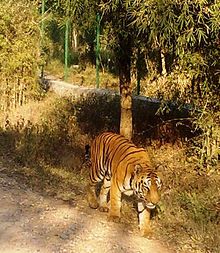
Bannerghatta Biological Park was created from a portion of the Bannerghatta
National Park in 2002. It is situated 22km south of Bangalore, Karnataka,
India. The journey to the park from Bangalore takes about one and one half
hours. This place is home to one of the richest natural zoological reserves.
The 25,000 acre (104.27 km²) zoological park makes this a major tourist
attraction in Bangalore.
Zoological Reserve
The zoological reserve shelters Indian tigers (including white tigers),
lions, and other mammals. The zoological reserve was founded after Shri
Y.M.L Sharma, Chief Conservator of Forests of Karnataka at that time,
petitioned the Government for a National Park in Bannerghatta. A Tiger &
Lion Safari and a Grand Safari are available as excursions provided by, and
at the park. The safaris are managed by the KSTDC, which also aids in
funding the reserve.
The park’s tiger reserve has been recognized by the Forest Department of
India.
Zoo
There is a small museum in the zoo used for showcasing special exhibits, in
addition to a reptile park and a small theater.
In 1992, a fifteen-year-old tiger at the park killed a five-year-old girl
who was on a safari with her family. After the tiger was captured, officials
considered killing it, but instead sent it to a zoo.
In 2003, authorities found evidence of embezzlement, unattended animals in
their cages, and malnourished animals.
Butterfly Park
The country's first Butterfly Park was established in the Bannerghatta
Biological Park. It was inaugurated on Saturday 25 November 2006 by Kapil
Sibal, Union Minister of Science and Technology.
The Butterfly Park is spread across 7.5 acres (30,000 m2) of land. It
comprises a butterfly conservatory, a museum, and an audiovisual room. The
butterfly conservatory, which is a circular enclosure with a poly-carbonate
roof, is 10,000 sq ft (1,000 m²). Inside the conservatory, the living
environment has been carefully designed to support more than twenty species
of butterflies.
The environment has a tropical setting, with a humid climate, an artificial
waterfall, and appropriate flora to attract butterflies.
The conservatory leads to the second and third domes, which house the museum
containing dioramas and exhibits of carefully preserved butterflies.
The collaborating agencies are the Zoo Authority of Karnataka, University of
Agricultural Sciences, and the Ashoka Trust for Research in Ecology and
Environment (ATREE).
Biological Reserve
Surrounding the park there is a biological reserve belonging to the forest
department. Among other animals, the reserve is home to elephants, leopards
and deer. The reserve belongs to an Elephant Corridor and is connected with
the B.R. Hills, Sathyamangalam forest areas extending all the way up to
Waynad.
Occasionally, there have been elephant sightings reported on the
Bantamweight-Anekal Road passing close to the Biological Reserve. In
addition, there was also one incident reported of a leopard entering the
premises of a school with her cubs; resulting in the school being shut down
for 3 days.
Getting There
Nearest airport is Kempegowda International Airport (IATA: BLR, ICAO: VOBL),
an international airport serving the Indian city of Bangalore. It is 4
kilometres (2.5 mi) south of Devanahalli and is 40 kilometres (25 mi) from
the central business district of Bangalore, (30 kilometres (19 mi) from the
Bangalore City Railway Station and covers 4,700 acres (1,900 ha).
undo ...back