Fort St. George
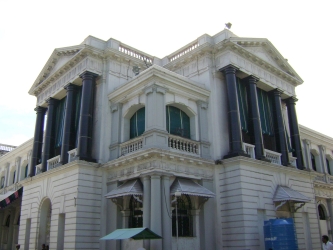
Fort St George (or historically, White Town) is the name of the first
English (later British) fortress in India, founded in 1644 at the coastal
city of Madras, the modern city of Chennai. The construction of the fort
provided the impetus for further settlements and trading activity, in what
was originally an uninhabited land. Thus, it is a feasible contention to say
that the city evolved around the fortress. The fort is one of the 163
notified areas (megalithic sites) in the state of Tamil Nadu.
History
The East India Company, which had entered India around 1600 for trading
activities, had begun licensed trading at Surat, which was its initial
bastion.
However, to secure its trade lines and commercial interests in the spice
trade, it felt the necessity of a port closer to the Malaccan Straits, and
succeeded in purchasing a piece of coastal land, originally called
Chennirayarpattinam or Channapatnam, from a Vijayanagar chieftain named
Damerla Chennappa Nayaka based in Chandragiri, where the Company began the
construction of a harbour and a fort. The fort was completed on 23 April
1644, coinciding with St George's Day, celebrated in honour of the patron
saint of England. The fort, hence christened Fort St George, faced the sea
and some fishing villages, and it soon became the hub of merchant activity.
It gave birth to a new settlement area called George Town (historically
referred to as Black Town), which grew to envelop the villages and led to
the formation of the city of Madras. It also helped to establish English
influence over the Carnatic and to keep the kings of Arcot and Srirangapatna,
as well as the French forces based at Pondicherry, at bay.
The Fort is a stronghold with six-meter high walls that withstood a number
of assaults in the 18th century. It briefly passed into the possession of
the French from 1746 to 1749, but was restored to Great Britain under the
Treaty of Aix-la-Chapelle, which ended the War of the Austrian Succession.
The Fort now serves as one of the administrative headquarters for the
legislative assembly of Tamil Nadu state and it still houses a garrison of
troops in transit to various locations at South India and the Andamans. The
Fort Museum contains many relics of the Raj era, including portraits of many
of the Governors of Madras. The fort is maintained and administered by the
Archaeological Survey of India as a ticketed monument.
Buildings inside the Fort
The Church
St. Mary's Church is the oldest Anglican church in India. It was built
between 1678 and 1680. The tombstones in its graveyard are the oldest
English or British tombstones in India.
This ancient prayer house solemnized the marriages of Robert Clive and
Governor Elihu Yale, who later became the first benefactor of Yale
University in the United States. The church is popularly known as the
'Westminster Abbey of the East'.
Museum
The Fort Museum exhibits many items of the period of English and later
British rule. This building was completed in 1795 and first housed the
office of the Madras Bank. The hall upstairs was the Public Exchange Hall
and served as a place for public meetings, lottery draws and occasional
entertainment. These relics are reminders of British rule in India. The
objects on display in the museum are the weapons, coins, medals, uniforms
and other artifacts from England, Scotland, France and India dating back to
the colonial period. Original letters written by Clive and Cornwallis make
fascinating reading.
One set of quaint period uniforms is displayed for viewing, as well.
However, the piece de resistance is a large statue of Lord Cornwallis. This
is a very modern building
Wellesley House
The first floor of the building includes the Banqueting Hall, which holds
paintings of the Governor of the Fort and other high officials of the
Regime. The cannons of Tipu Sultan decorate the ramparts of the museum. The
14.5 ft statue stands at the entrance near a stairway in the museum. This
statue was created by Charles Bank in England to be brought to India. The
pedestal of the statue is carved with a scene depicting Tipu Sultan's
emissary handing over Tipu's two sons as hostage in lieu of a ransom he was
unable to pay to the British. It takes its name from Richard Wellesley,
Governor General of India, and brother of the Duke of Wellington.
Flag staff
The flag staff at the fort is the tallest in the country. Made of teakwood,
it is 150 feet high.
In Recent Years
Fort St George complex housed the administrative buildings of the Government
of Tamil Nadu till March 2010. The Legislature of Tamil Nadu and the
secretariat (with headquarters of various government departments) was
situated in the fort. The fort itself was open to the public however only to
a certain area. The main building or the secretariat was open only to
government officials and the police. The cannons and the moat which guarded
this old building have been left untouched. In 2010 the legislature and the
secretariat moved to a new location and the old assembly complex was
converted into a library for the Central Institute of Classical Tamil.
Following the 2011 assembly elections and the return of J Jayalalithaa as
the Chief Minister of the State, the Tamil Nadu Assembly and the Secretariat
have been restored to Fort St George.
Other Monuments
An arch commemorating the diamond jubilee of Tamil Nadu Legislative Assembly
is under construction near the Fort on Rajaji Salai close to Napier Bridge.
The structure is a replica of Fort St. George's façade. The arch will be
rectangular in structure with a height of 41 feet and 80 metres width being
built at a cost of 13.3 million. The structure will be a mix of old and
modern architecture, inspired by the frontage of Fort St. George. The legend
'Tamil Nadu Legislative Assembly diamond jubilee commemorative arch' would
be inscribed in English and Tamil, in addition to the words '60 years'. The
chief minister J. Jayalalitha laid the foundation stone for the arch on 30
October 2012. Earlier, the arch was planned to be constructed close to the
entrance of Fort St. George, but was later relocated beyond the prohibitive
zone following the objections of archaeologists. A public interest
litigation (PIL) was filed in the Madras High Court opposing the move
stating that the arch would choke Rajaji Salai that leads to the High Court.
However, the petition was dismissed by a division bench on 9 January 2013.
Getting There
The nearest airport to this attraction is
Chennai International Airport
(IATA: MAA, ICAO: VOMM), the primary airport serving the southern Indian
metropolis of Chennai.
undo ...back