Government Museum Chennai
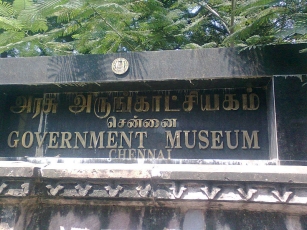
Egmore Museum, established in 1851, is located in Egmore, Chennai. Known as
the Madras Museum, the museum is the second oldest museum in India, the
first being the Indian Museum at Kolkata, started in 1814. It is also one of
the largest museums in South Asia. It is particularly rich in archaeological
and numismatic collections. It has the largest collection of Roman
antiquities outside Europe.
Many of the buildings within the Museum campus are over 100 years old. Among
them, the colossal Museum Theatre is one of the most impressive. The
National Art Gallery is also present in the museum premises. Built in Indo-Saracenic
style, it houses rare works of artists like Raja Ravi Varma.
Location
The museum is located in what is known as the Pantheon complex, or "public
assembly rooms." It is located on the Pantheon Road in Egmore. The road on
which the museum is located too takes its name from the complex.
History
In August 1778, the governor of Madras granted 43 acres for an estate to a
civil servant, who, subsequently in 1793, assigned the grounds to a
committee of 24 which then regulated the public amusements in the city. In
1821, the committee sold the main house and central garden space to E. S.
Moorat, an Armenian merchant who, in turn, sold it back to the government in
1830. The government first used the buildings and the grounds as the
collector's "Cutcherry" and later for the "Central Museum."
The museum was originally established in a building on College Road in
Nungambakkam in the year 1851 and was shifted to the present site in 1854.
Many additions to the original building were constructed between 1864 and
1890. The core of the old museum building includes the only surviving
remnants of the Pantheon, identified from the broad steps leading into it
when viewed from the north. Amongst the additions is the Connemara Public
Library, built with stained glass windows, ornate woodwork and elaborate
stucco decorations, formally opened in 1896 and named after its progenitor.
The building was built by Namberumal Chetty and was designed by Henry Irwin,
with the interiors resembling those of Bank of Madras (SBI).
The design included a huge reading room with a wooden ceiling between two
curved rows of stained glass, supported by ornate pillars and arches
embellished with sculpted acanthus leaves. It was supplemented with teakwood
furniture, marbled floor, and decorative windows. All of these were restored
in 2004-2007. The building now houses the Old Collection (pre-1930), which
is used for reference purpose only.
Both the museum and the library benefited greatly from the effects of the
Madras Literary Society, the Oriental Manuscripts Library and the Records
Office. The museum houses a 19th-century theatre, with the "pit" meant for
those who can afford more and seating for the rest of the audience in
tiered-seats arranged in a semi-circle around the pit. Restoration to mark
the 150th anniversary of the museum replaced 25 fans with air-conditioning.
The museum's collections had its origin from a gift of a collection of 1,100
geological specimens by the Madras Literary Society to the Government in
1851.
The museum, the first government-sponsored one in the country, opened the
same year on the first floor of the College of Fort St. George, adjacent to
the Literary Society in Nungambakkam, with an exhibit of nearly 20,000
freely gifted specimens ranging from rocks to books. These gifts were in
response to a public invitation that did not have a cut-off date. When the
mounting collection of geological specimens threatened the stability of this
first floor, the museum's first officer-in-charge, Surgeon Edward Balfour,
who was then president of the Literary Society and serving the museum in an
honorary capacity, suggested moving to a new building, which was
materialised in 1854 with the move to the Pantheon. A library and a reading
room were provided for the public in 1859.
In 1864, an upper storey was added to the Pantheon in sympathetic style,
giving the museum more elbow room. The library got a new block, now known as
the centenary exhibition hall of the museum after restoration, in the
northwest corner of the Pantheon in 1876, with a lecture hall. By 1896,
there had been built new buildings for the museum (where the anthropological
and arms galleries are presently located), the Connemara Library and the
museum theatre.
The museum grounds also housed the first zoo of Madras in 1855, which was
also established by Balfour. A year later, it had over 300 animals,
including mammals, birds and reptiles. The zoo was later made a separate
institution and was shifted to the People's Park in 1863 where it remained,
not growing very much, till it was moved to its present location at Vandalur
in 1985.
An official website for the museum was launched on 25 October 2001 after the
government sanctioned 0.5 million in 2000-2001.
The Museum complex
The museum complex consisting of six buildings and 46 galleries covers an
area of around 16.25 acres (66,000 m²) of land. The objects displayed in the
museum cover a variety of artifacts and objects covering diverse fields
including archeology, numismatics, zoology, natural history, sculptures,
palm-leaf manuscripts and Amravati paintings.
Located close to the main museum entrance gates on Pantheon Road, the museum
theatre is a rare specimen of the Italianate style of architecture, inspired
by Classical architecture and developed in 1802 at Britain by John Nash.
However, the theatre was built by the British in the late 19th century when
this style was no longer popular in England.
The structure has a high plinth and is accessed through a tall flight of
stairs. It is primarily a semicircular structure with a rectangular wing at
the rear. The latter wing now houses some of the galleries of the museum.
The main hall is accessed through a verandah with a row of columns linked by
semicircular arches. The walls and columns are embellished with floral and
geometric designs.
The huge main hall was initially designed for staging theatrical
performances. It has around 600 seats and a commodious stage and the actors'
dressing rooms adjoin this stage. During the British era, the theatre was
mainly used for staging English plays preferred by the British elite of the
city.
Now, the museum has been using the theatre for its own cultural and academic
programs such as art workshops, lectures and conferences. It also rents the
hall for various cultural performances, mainly dramas. The hall has
witnessed several plays including those of Shakespeare.
Since August 2004, the museum is also a designated "Manuscript Conservation
Centre" (MCC) under the National Mission for Manuscripts established in
2003. The museum has taken preventive care of about 19,007 manuscripts and
given curative conservation treatment to about 7,402 manuscripts.
The museum for children in the complex houses several static exhibits such
as galleries of dolls adorned with costumes of various nations and
civilisations and also exhibits pertaining to science, transportation, and
technology.
Visitors
As of 2023, the children's museum is visited by 1,000 people a day, and the
number of visitors increases during weekends.
Future Plan
An air-conditioned 3D theatre, the first of its kind facility in a state
museum, is under construction at the children's museum in the museum complex
at a cost of 4 million. Equipments are to be provided by the National
Council of Science Museums, Kolkata. The theatre will screen
science-oriented films. It screen a 20-minute long film and will play five
shows a day. The project is expected to be completed by April 2013. There
are also plans to upgrade the 3D treatre to a 5D.
Getting There
The nearest airport to this attraction is
Chennai International Airport
(IATA: MAA, ICAO: VOMM), the primary airport serving the southern Indian
metropolis of Chennai.
undo ...back