Guindy National Park
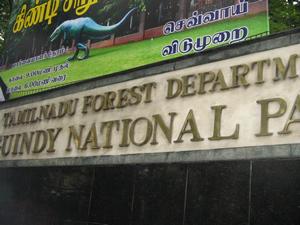
Guindy National Park is a 2.82 km2 (1.09 sq mi) Protected area of Tamil Nadu,
located in Chennai, South India, is the 8th smallest National Park of India
and one of the very few national parks situated inside a city. The park is
an extension of the grounds surrounding Raj Bhavan, formerly known as the 'Guindy
Lodge', the official residence of the Governor of Tamil Nadu, India.
It extends deep inside the governor's estate, enclosing beautiful forests,
scrub lands, lakes and streams. The park has a role in both ex-situ and
in-situ conservation and is home to 400 blackbucks, 2,000 spotted deers, 24
jackals, a wide variety of snakes, geckos, tortoises and over 130 species of
birds, 14 species of mammals, over 60 species of butterflies and spiders
each.
There are a wealth of different invertebrates - grasshoppers, ants,
termites, crabs, snails, slugs, scorpions, mites, earthworms, millipedes,
and the like. These are free-ranging fauna and live with the minimal of
interference from human beings. The only major management activity is
protection as in any other in-situ conservation area. The park attracts more
than 700,000 visitors every year.
History
Once covering an area of 5 km2 (1.93 sq mi) of one of the last remnants of
tropical dry evergreen forest of the Coromandel Coast, Guindy Park was
originally a game reserve. In the early 1670s, a garden space was carved out
of the Guindy forest and a residence called the Guindy Lodge was built by
Governor William Langhorne (1672–1678), which had helped make St Thomas
Mount a salubrious place for rest and recreation. The remaining of the
forest area was owned by a British citizen named Gilbert Rodericks from whom
it was purchased by the government in 1821 for a sum of 35,000.
The original area of 505 ha was established as a Reserve Forest in 1910.
Chital (spotted deer) were introduced into the park probably after 1945.
Between 1961 and 1977, about 172 ha of the forest, primarily from the Raj
Bhavan, was transferred to various government departments in order to build
educational institutions and memorials.
In 1958, a portion of the forest area was transferred to the Union Education
Ministry for establishing the Indian Institute of Technology, Madras. In the
same year, another portion of the land was transferred to the Forest
Department for creating the Guindy Deer Park and Children's Park at the
instance of the then prime minister of India, Jawaharlal Nehru.
Memorials for Rajaji and Kamaraj were built in 1974 and 1975, respectively,
from parcels of land acquired from the Raj Bhavan. In 1977, the forest area
was transferred to the Tamil Nadu Forest Department. In 1978, the whole of
the remaining area, popularly known then as the Guindy Deer Park, was
declared a national park. It was walled off from the adjacent Raj Bhavan and
Indian Institute of Technology Madras Campus in the late 1980s.
Habitats
The Guindy National Park, Raj Bhavan and IIT-Madras habitat complex has
historically enjoyed a certain degree of protection and has continued to
support some of the last remnants of the natural habitats that typify the
natural range of plant and animal biodiversity of the Coromandel-Circar
coastal plains in the northeastern Tamil Nadu. The ecosystem consists of the
rare tropical dry evergreen scrub and thorn forests receiving about 1200 mm
of rainfall annually. This vegetation has been reclassified as the Albizia
amara Boiv community.
The region’s physiognomy occurs as discontinuous or dense scrub-woodlands
and thickets, containing species such as introduced Acacia planifrons,
Clausena dentata shrubs, palmyrah palm (Borassus flabellifer), Randia
dumetorum, Randia malabarica, Carissa spinarum, Acacia chundra, exotic
cactus Cereus peruviana and Glycosmis mauritiana.
The park has a tropical dissymmetric climate. The mean annual temperatures
are 32.9 °C (maximum) and 24.3 °C (minimum). Rainfall ranges from 522 to
2,135 mm, with an average annual rainfall of 1,215 mm. The summer season in
April and May determines the peculiar vegetation of the Coromandel-Circar
coast. Between June and December, wet season prevails, with dry season
occurring between January and March. The area also has a cleared meadow
called Polo Field measuring about 230 × 160 m. The park also has a lake
known as the 'Tangal Eri'.
The park is protected by a perimeter wall for a length of 9.5 km. There is
an extensive network of roads and trails. The road network covers about 14
km within the park. The park has two large tanks, namely, Kathan Kollai (KK
Tank) and Appalam Kolam (AK Tank), in addition to two ponds, which usually
dry up during summer. The presence of the park and the surrounding green
areas resulted in the byname, the green lungs of Chennai, for the Adyar–Guindy
area.
Flora
The park has a dry evergreen scrub and thorn forest, grasslands and water
bodies with over 350 species of plants including shrubs, climbers, herbs and
grasses and over 24 varieties of trees, including the Sugar-apple, Atlantia
monophylla, Wood-apple, and Neem. This flora provides an ideal habitat for
over 150 species of birds. About one-sixth of the park has been left as open
grassland to preserve that habitat for blackbucks. Though both the species
of blackbuck and spotted deer have their natural habitat in grassland, the
spotted deer prefer bushes and can adjust in land covered with shrubbery.
Fauna
There are over 14 species of mammals including blackbuck, chital or spotted
deer, jackal, small Indian civet, common palm civet, bonnet macaque, hyena,
jackal, pangolin, hedgehog, common mongoose and three-striped palm squirrel.
The park also has black-naped hare and several species of bats and rodents.
The Near Threatened blackbuck, considered the flagship species of the park,
was introduced in 1924 by Lord Willingdon and has seen a population decline
in recent times. While blackbucks are a native faunal element of the park,
chitals were introduced into the park from the Government House on Mount
Road when Raj Bhavan was developed, probably in the late 1940s, although the
exact date is not known.
Some albino male blackbucks were also introduced by the Maharaja of
Bhavnagar. Per the census conducted on 29 February 2004, the population of
Blackbuck was 405 (10 spotted in the IIT campus). The chital population in
the Park, however, appears to have been steady or even increased since their
introduction into the area many decades ago. Per the census conducted on 29
February 2004, the population of the spotted deer was 2,650.
Of these, 1,743 were female and 336 were fawns. The census was taken in the
Guindy National Park and the adjoining areas of the Indian Institute of
Technology and the Raj Bhavan campus using King's transect method, which
would only reveal the numbers close to the actual figure.
The park has over 150 species of birds including grey partridge, crow
pheasant, parrot, quail, paradise fly-catcher, black-winged kite, Honey
Buzzard, pariah kite, Eagle, golden-backed Woodpecker, yellow-wattled
lapwing, red-wattled lapwing, blue-faced malkoha, shrike, koel, minivet,
munia, parakeet, tailor bird, robin, drongo, quail and stone curlew. Bird
watchers anticipate migratory birds here like teals, garganeys, pochards,
medium egrets, large egrets, night herons, pond herons and open-billed
storks every fall season.
The park is home to about 9 species of amphibians. There are also many kinds
of reptiles, including saw-scaled viper and the fan-throated lizard. Some
species of tortoise and turtles especially the endangered star tortoise,
lizards, geckos, chameleons and the common Indian monitor lizard are found
here, as well as a large variety of insects including 60 species of spiders
and 60 species of butterflies.
Guindy Snake Park, formerly the location of Madras Crocodile Bank Trust, is
next to the Guindy National Park. The Snake Park in Chennai gained statutory
recognition as a medium zoo from the Central Zoo Authority in 1995. There
one can see King Cobra, pythons, vipers and other reptiles.
For ex-situ conservation, about 22 acres (8.9 ha) of the Guindy National
Park has been carved out into a park known as the Children's Park and play
area at the northeast corner of the national park with a collection of
animals and birds. The Children's Park gained statutory recognition as a
medium zoo from the Central Zoo Authority in 1995.
Animals in the Children’s Park include black buck, sambar, spotted deer,
porcupine, hyena, jackal, python, grey pelican, night heron, cormorant,
cockatiel, parrot, mongoose, common peafowl, crocodile, common otter, rhesus
monkey, bonnet monkey and common langur. The Children's Park also exhibits a
fossilised tree specimen which is estimated to be about 20 million years old
and a statue of a Tyrannosaurus at the entrance.
The Children's Park and the Snake Park have separate entrances and
independent entry fees. Drinking water, vendors and catering are available.
The entrance lies on the busy Sardar Patel Road next to the Adyar Cancer
Institute.
Visitor Information
There is a new interpretation center about the biodiversity of the park.
Entry into this protected reserve is restricted, and visitors can go into
the core area only when escorted by a forest ranger from the Forests
Department. The rear southeast edge of the park adjoins the campus of Indian
Institute of Technology. Along its northern fringes on the Sardar Patel road
are the Cancer Institute, CLRI campus, the Anna University, the Raj Bhavan
and spaces allotted for the Gandhi Mandapam, Kamaraj Memorial and Rajaji
Memorial.
The visiting timings at the Snake Park is from 9.00 am to 5.30 pm Children's
Park is from 9.00 am to 6.00 pm and is open on all days except Tuesday which
is declared as a holiday.
The nearest railway station is the Kasturibai Nagar MRTS station which is
less than a kilometer away. Guindy station (Suburban Track) is 1 km away.
Chennai Egmore Railway station is 9 km away. Chennai Central Railway station
is 12 km away. Chennai airport is 8 km away.
For more details contact the Wildlife Warden, 50, IV Main Road, Gandhi Nagar,
Adyar, Chennai – 600 020. or The Wildlife Warden, 259, Anna Salai, DMS
Compound, IV Floor, Teynampet, Chennai 600 006 Phone : 24321471 or the
Children's Park, Guindy.
Getting There
The nearest airport to this attraction is
Chennai International Airport
(IATA: MAA, ICAO: VOMM), the primary airport serving the southern Indian
metropolis of Chennai.
undo ...back