Parthasarathy Temple
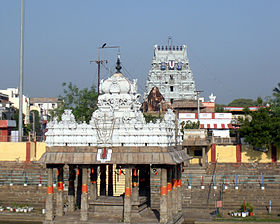
The Parthasarathy Temple is an 8th-century Hindu Vaishnavite temple
dedicated to the god Krishna, located at Triplicane, Chennai, India. The
temple is glorified in the Divya Prabandha, the early medieval Tamil
literature canon of the Alvar saints from the 6th–9th centuries CE and is
classified as among the 108 Divya Desams dedicated to Vishnu. The name 'Parthasarathy',
in Sanskrit, means the 'charioteer of Arjuna', referring to Krishna's role
as a charioteer to Arjuna in the epic Mahabaratha.
It was originally built by the Pallavas in the 8th century by king
Narasimhavarman I. The temple has five of the incarnations or avatars of
Vishnu: Narasimhar, Ramar, Varadarajar, Ranganathar and Krishna.
The temple is one of the oldest structures in Chennai. There are shrines for
Vedhavalli Thayaar, Ranganatha, Rama, Gajendra Varadharaja Swamy, Narasimha,
Andal, Anjaneya, Alvars, Ramanuja, Swami Manavala Mamunigal and
Vedanthachariar. The temple subscribes to Vaikhanasa agama and follows
Thenkalai tradition. There are separate entrances for the Krishna and
Narasimha temples. The gopuram (towers) and mandapas (pillars) are decorated
with elaborate carvings, a standard feature of South Indian Temple
Architecture.
History
The temple was originally built by the Pallavas in the 8th century,
subsequently expanded by Cholas and later by the Vijayanagara kings in the
15th century. The temple has several inscriptions dating from the 8th
century in Tamil and Telugu presumably from the period of Dantivarman, who
was a Vishnu devotee. Thirumangai Alvar, the 9th century alvar also
attributes the building of temple to the Pallava king. From the internal
references of the temple, it appears that the temple was restored during
1564 CE when new shrines were built. In later years, endowments of villages
and gardens have enriched the temple. The temple also has inscriptions about
the Pallava king, Nandivarman of the 8th Century.
The temple was extensively built during the Chola period and a lot of
inscriptions dating back to the same period are found here. The outer most
mandapam is replete with sculptures of various forms of Vishnu, especially
the avatars. One can also see inscriptions of Dantivarma Pallava of 8th
Century, Chola, Pandiya and Vijayanagara in the temple. The first
architectural expansion of the temple took place during the reign of the
Pallavas (Tondaiyar Kon) as vividly described by Tirumangai Azhwar.
Reminiscent of this is the inscription of the Pallava King Dantivarman
(796-847 A.D.), which is preserved in the temple. The temple witnessed a
major expansion during the rule of the Vijayanagar kings like Sadasiva Raya,
Sriranga Raya and Venkatapati Raya II (16th Century). Many subshrines and
pillared pavilions (mandapas) like the Tiruvaimozhi Mandapa were added.
Tiruvallikeni may not be as serene as Tirumangai Azhwar described it, but
the aura remains because of the Parthasarathy Swamy temple.
A Pallava king built the present temple in the eighth century. The gopuram
was also built by a Pallava king - Tondaiman Chakravarthy. There are
inscriptions that record the contributions of the Chola kings Raja Raja and
Kulottunga III, Pandya King Maravarman and many rulers of the Vijayanagar
dynasty including Ramaraja Venkatapathiraja and Vira Venkatapathy. For a
while the East India company administered the temple. The pushkarani is
called Kairavani and five sacred teerthams are believed to surround the tank
- Indra, Soma, Agni, Meena and Vishnu. Seven rishis - Bhrigu, Atri, Marichi,
Markandeya, Sumati, Saptaroma and Jabali - performed penance here. All five
deities in the temple have been extolled by Tirumangai Azhvar.
Tiruvallikeni is noted for its colourful festivals throughout the year. The
recitation of the 4000 hymns of the Azhwars is a great tradition preserved
in this temple for generations.
The Temple
The temple has two gopurams (tower) each in eastern and western directions.
The temple has five vimanams namely Anatha Nilaya Vimanam over Parthasarathy
shrine, Ranganathar Sannathy vimanam, Ramar sannathy vimanam, Narasimha
sannidhi vimanam and Andal Sannithi vimanam. The temple tank called "Thiruallikeni"
is derived from the place where Vishnu's consort Lakshmi herself was born as
Vedavalli to Sage Bhrigu. The tank contains five wells and lies opposite to
the eastern entrance of the temple.
The temple has two main shrines built back-to-back. The Mulavar (main
deity), Parthasarathy alias Venkata Krishnan, faces East. Along with his
consort Rukmani Piratiyar, he holds sword in one hand (this is debatable
since the official site says he holds conch in his right hand, as he had
promised not to take up arms in mahabharat war), Varadha Muthirai on the
other hand. Krishna's brother Balarama is positioned on his right, Satyaki
to his left; Krishna's son Pradyumna and grandson Aniruddha are also found
in the sanctum. This is one of the Vishnu temples where the Vishnu is
present along with his three generations. The shrine of the consort,
Vedavalli Thayaar, is located parallel to the sanctum. The shrine of
Narasimha (Thellia Singhar) faces west and just as the main sanctum, there
is a separate entrance and flag post (Dwajasthambam) for Narasimha.
The deity is seated in Veetrirundha Yoga thirukola (Sitting Posture). There
is a shrine for Ranganatha (Sri Mannanathar) and Ramar located in the
passage to the main sanctum. Ranganatha is in Bujanga Sayanam, reclining
posture facing east. There is a shrine of Gajendra Varadar. There is a
shrine for Rama (an avatar of Vishnu), known here as Chakravarthi Thirumagan.
He is seen here with his entire family, i.e., consort Sita Piratti, brothers
Lakshmana, Bharatha, Shathrugna and devotee Hanuman opposite to the shrine
of Ramar.
It is one of the very few shrines in the country dedicated to Krishna as
Parthasarathy, charioteer of Arjuna and to contains idols of three avatars
of Vishnu: Narasimha, Rama, and Krishna. Because of the association of the
temple with Krishna, Tiruvallikeni came to be regarded as the Southern
Brindavana.
Legend
Triplicane owes its name to its historic existence as Tiruvallikeni (or
Thiruvallikeni) or Tiru-Alli-Keni (Sacred Lily Pond, in Tamil) denoting the
pond in front of the temple, amidst a big Tulasi forest. The place was also
referred to as Vrundha-raNyam (beautiful garden) in Puranic scriptures.
Krishna was the charioteer for the Pandava prince Arjuna during the
Kurukshetra War war in the epic Mahabaratha. Kunti (also called Pritha),
Arjuna's mother was the aunt of Krishna and the sister of Krishna's father,
Vasudeva. Krishna addressed Arjuna as Partha, the son of Pritha. Krishna was
thus referred as Partha Sarthy, meaning the charioteer of Arjuna. The
Bhagavat Gita is a conversation between Krishna and Arjuna taking place in
the middle of the battlefield before the start of the war with armies on
both sides ready to battle. Responding to Arjuna's confusion and moral
dilemma about fighting his own cousins who command a tyranny imposed on a
disputed empire, Lord Krishna explains to Arjuna his duties as a warrior and
prince, and elaborates on yoga, Samkhya, reincarnation, moksha, karma yoga
and jnana yoga among other topics.
Krishna was neutral during the war, giving his army to Kauravas and offered
himself for the Pandavas. Parthasarathy in the temple is thus depicted with
a moustache and having only the conch, without his weapon Chakra. This is
attributed to the promise he made to the Kauravas not to take weapons during
the war.
Following the traditions of a charioteer, he sported the moustache and the
same is depicted in the temple. The scars in the face of Parthasarathy's
festival idol (presumably made of aimpon, an alloy of five metals) in the
temple is full of scars depicted to show the injuries caused by the arrows
of Bhishma in the war. The utsavar (festival deity) also has only a stick
depicting Krishna was born in a cowherd clan.
Venkateswara, another form of Vishnu, appeared as Parthasarathy to fulfil
his promise to King Sumathi that he would give darshan to the king in this
form. Sage Athreya had installed the idol of Parthasarathy. Legend has it
that the parents of the Sri Vaishnava saint, Ramanuja came to the temple and
prayed to the Lord for a son and eventually the saint was born. It is also
believed that the Ramanuja is none other than Parthasarathy himself who was
born to revive Vishishtadvaita.
Vedavalli Thayar is said to be born to Sage Bhrigu as a result of his
penance in the banks of Kairaveni in a lily pond (Alli keni). The legend
says, that so many kings attempted to marry Thayar, but she chose Ranganatha
in the midst of many kings and called the lord vaarum en manare, means
"Welcome, my lord of this universe". The celestial wedding took place
between Vedavalli Thayar and Sri Mannanathar on 12th Day (Dwadashi) during
the month of Thai - Masi. The wedding is celebrated every year. Vaikasi
Festival is exclusively held of the presiding deity Gajendra Varadhar. It is
said that Rama appeared here on the request by Sage Madhuman in
Thirvallikeni. A grand festival of Rama Navami is celebrated here for 9 days
in the Tamil month of Panguni.
Literary Mention
The temple is glorified in the Divya Prabandha, the early medieval Tamil
literature canon of the Alvar saints from the 6th–9th centuries CE and is
classified as among the 108 Divya Desam temples, dedicated to Vishnu. Among
the 12 Alvars, three of them namely Peyalwar, Thirumazhisai alwar and
Thirumangaialwar have sung on the different forms of God in this temple.
Many acharyas have also written songs on the various deities in this temple.
Thirumangai Alvar wrote of Tiruvallikeni as an area so densely wooded that
the sun's rays cannot penetrate the canopy formed by the tree tops. He also
said Tiruvallikeni was a home for beautiful birds like peacocks and Koels.
However, Triplicane is changed over time and these features of the city are
lost. He also mentioned about the Telliya Singar shrine within the temple.
Darshan, Sevas and Festivals
The temple is administered by the Hindu Religious and Endowment Board of the
Government of Tamil Nadu. The temple follows the traditions of the Thenkalai
sect of Vaishnavite tradition and follows vaikanasa aagama. The temple has
grand brahmotsavams (big festival) for Sri Parthasarathy swami during the
Tamil month of Chittirai (April–May),on the same month Udayavar uthsavam is
also celebrated. In the month of Vaigasi, Sri Varadarajar uthsavam, Sri
Nammalwar uthsavam (vaigasi-visagam) and Vasanthothsavam are celebrated. Sri
Azhagiyasingar (Lord Narashimha) during the Tamil month of Aani (June–July).
So uniquely two Bhrammotsavams are performed here annually. There are also
festivals for Sri Ramanuja (April–May) and Sri Manavalamamunigal (Oct-Nov)
besides festivals for Alwar and Acharyas. Vaikunta Ekadesi and during the
Tamil month of Margazhi (December–January) draws lot of pilgrims.
Utsavams
These take place round the year in Parthasarathy temple. Urchavams (or
utsavams), as these are termed, take place for a particular god at a
particular period of time in the year. It's a religious practise to carry
the different gods of the temple through the mada veethis of triplicane
during some of these festivals. The Gods will move in different religiously
built temple vehicles (vaghanams, as these are termed in Tamil), like
Elephant, Garuda, horse, Yaali (a mythical animal), temple rath (ther in
Tamil, chariot or ratham, alternative terms), etc.
Getting There
The nearest airport to this attraction is
Chennai International Airport
(IATA: MAA, ICAO: VOMM), the primary airport serving the southern Indian
metropolis of Chennai.
undo ...back