Tomb of Akbar the Great
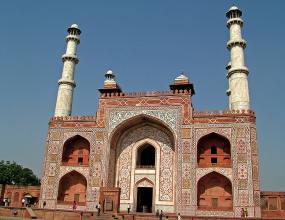
The Tomb of Akbar the Great is an important Mughal architectural
masterpiece, built 1605–1613, set in 48 Ha (119 acres) of grounds in
Sikandra, a suburb of Agra, Uttar Pradesh, India.
History
The third Mughal Emperor Akbar the Great (1555–1605), himself commenced its
construction in around 1600, according to Tartary tradition to commence the
construction of one's tomb during one's lifetime. Akbar himself planned his
own tomb and selected a suitable site for it. After his death, Akbar's son
Jahangir completed the construction in 1605-1613. Akbar was one of the
greatest emperors of his time.
Location
It is located at Sikandra, in the suburbs of Agra, on the Mathura road
(NH2), 8 km west-northwest of the city center. About 1 km away from the
tomb, lies Mariam's Tomb, the tomb of Mariam-uz-Zamani, wife of the Mughal
Emperor Akbar and the mother of Jahangir.
Architecture
The south gate is the largest, with four white marble chhatri-topped
minarets which are similar to (and pre-date) those of the Taj Mahal, and is
the normal point of entry to the tomb. The tomb itself is surrounded by a
walled enclosure 105 m square. The tomb building is a four-tiered pyramid,
surmounted by a marble pavilion containing the false tomb. The true tomb, as
in other mausoleums, is in the basement.
The buildings are constructed mainly from a deep red sandstone, enriched
with features in white marble. Decorated inlaid panels of these materials
and a black slate adorn the tomb and the main gatehouse. Panel designs are
geometric, floral and calligraphic, and prefigure the more complex and
subtle designs later incorporated in Itmad-ud-Daulah's Tomb.
Sources: Wikipedia
undo ...back